

Skip to content

Italian brand

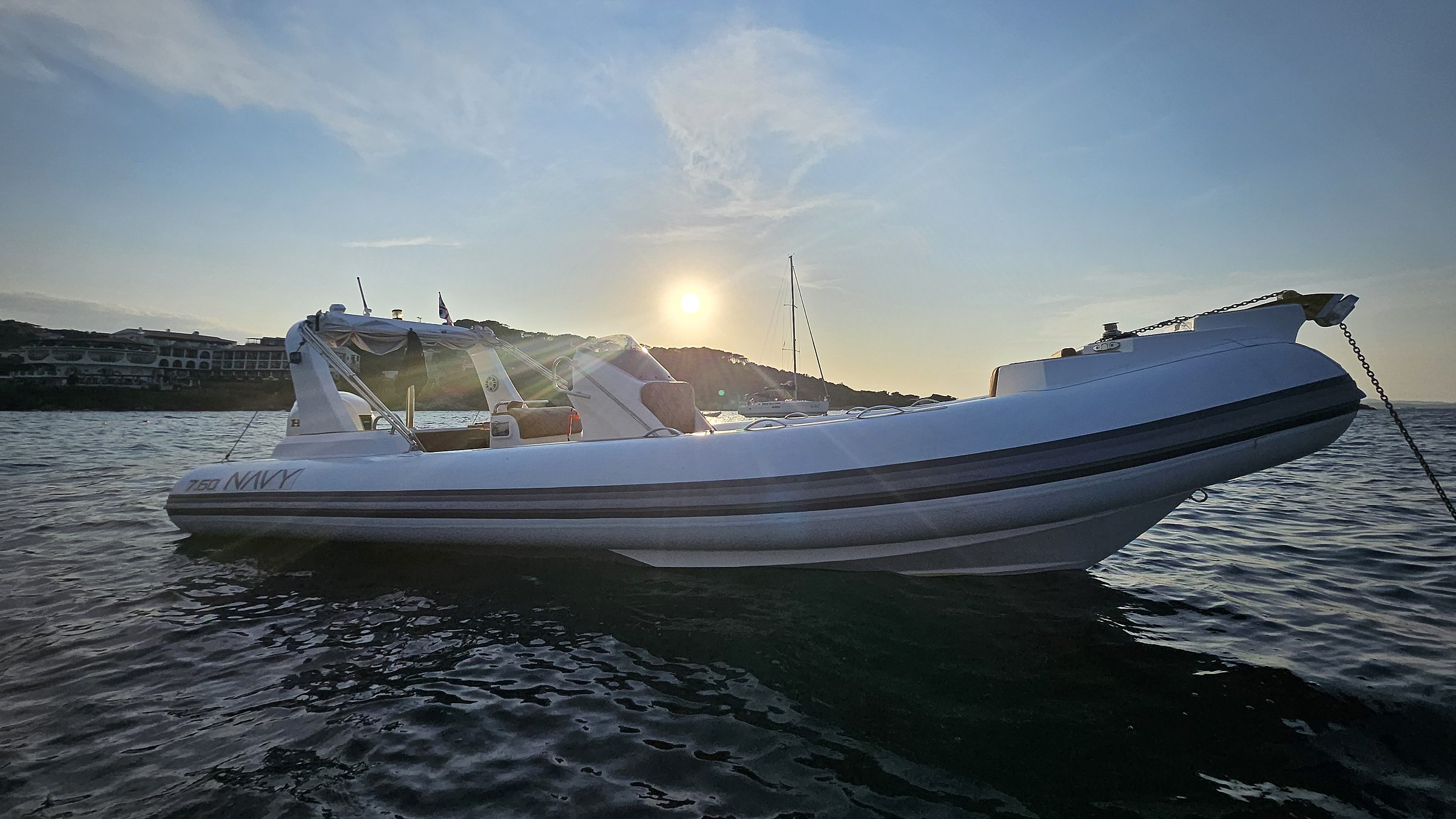
NAVY 7.60 bow in the foreground with anchor chain and the sun low on the horizon

PLATE 01

The Naviglia Yachts guides · real photograph

Guides to choosing
the right RIB

Call +39 380 173 0961Message us on WhatsApp

A RIB is chosen in five moves, always in the same order: the size, which depends on how many people you carry and where you go boating; the engine, which in Italy also decides whether you need a boat licence; the fabric of the tubes; the hull; the final bill, made up of price + VAT, engine and transport. Here you will find a guide for each move, with the real figures of the NAVY range and the article of law alongside, written the way we answer the phone: straight to the point.

7 main guides · 9 in-depth guides · prices from the public price list · updated 14 October 2026

Book your visitBook a sea trial

PLATE 02

Where to start

Before you choose,
the right questions

These guides grew out of the questions we are asked most often, on the phone and on WhatsApp, by people about to buy their first RIB and by those moving up to a bigger size. They are always the same five: what it really costs, whether you need a licence, how much horsepower to hang on the transom, what the tubes are made of, how the hull behaves when the sea gets up. We have put them in writing once and for all, with one rule: every sentence states a fact, and every fact has its measurement or its source.

The prices are those of our public price list, plus VAT and engine not included, with the VAT-inclusive amount already worked out. The rules are Italian and are cited by article, from the Italian Recreational Boating Code to the European directive on recreational craft. Where a figure depends on your boat, we say so and tell you where to read it: on the builder's plate, in the engine handbook, on the declaration of conformity.

White NAVY 7.60 at anchor, bow three-quarter view, white houses and granite rocks behind
FIG. 01 — The bow faces the viewer, the anchor chain taut in the water. Low-angled light picks out the white tube and the grey bands; behind, white houses among the pines and a granite ridge. At anchor in the bay, a row of small RIBs. Every guide starts here: a real boat, in real water.

The seven main guides

Seven guides,
one per question

Each one answers a single question and brings you to the quote with a clear idea of what you want. The order is that of someone about to buy: first the price, then the licence, then the engine, then the materials; for anyone looking at the 9.50, the cabin and the hull.

White NAVY 7.60 at anchor in the golden hour, warm reflections and a granite coast
FIG. 02 — White NAVY 7.60 at anchor in the golden hour, warm reflections and a granite coast.

Guide 01 · The price

How much does
a RIB cost

The list price is only the first line of the bill. On our public price list the NAVY 4.80 starts from €13,924 + VAT · engine not included, that is €16,987.28 incl. 22% Italian VAT; the NAVY 7.60 starts from €33,000 + VAT · engine not included; the NAVY 9.50 Cabin sells from €86,900 + VAT · engine not included. To this figure you add the engine, which you choose separately by power and brand, the options you really want, the trailer if the boat travels by road and transport to your harbour, which you will find written in the quote.

The guide lists every item, one by one, and explains why two RIBs of the same length can be priced far apart: the fabric of the tubes, the thickness of the fibreglass, the standard equipment. The trailer is a separate item too: on the NAVY 7.60 the 8-metre trailer is listed at €8228 plus VAT, and the engine remains excluded. By the end you know what to ask anyone who makes you an offer: the final figure, with VAT and engine, in front of you.

Read the guide

Stainless wheel and instruments on the white console of the NAVY 6.00, with grey EVA deck
FIG. 03 — Stainless wheel and instruments on the white console of the NAVY 6.00, with grey EVA deck.

Guide 02 · The rules

When you need
a licence

In Italy the boat licence does not depend on the boat: it depends on where you go and what engine is on the transom. Art. 39 of the Italian Recreational Boating Code makes it compulsory beyond 6 miles from the coast, whatever the engine, and always on jet skis. Within 6 miles, and on inland waters, it is required only if the engine exceeds 30 kW, that is 40.8 hp, or the cylinder capacity set for its type: for a four-stroke outboard the limit is 1,000 cc. To do without a licence, power and cylinder capacity must both stay below the threshold.

Below those thresholds a RIB with a hull of up to 10 metres, that is a natante under Italian law, can be helmed without a licence from the age of 16. The guide also explains the D1 licence, introduced in 2024 for 16-year-olds, and the licence categories A, B, C and D. On the NAVYs it translates simply: with the 40 hp we recommend up to the 6-metre, so the NAVY 4.80, the NAVY 5.50 and the NAVY 6.00.

Read the guide

Dead-astern view of the NAVY 7.60: Honda 250 VTEC centred between the two swim platforms
FIG. 04 — Dead-astern view of the NAVY 7.60: Honda 250 VTEC centred between the two swim platforms.

Guide 03 · The engine

How much power
you need

The right power depends on the size, the load and what you do at sea: someone heading for a swim in the next bay does not have the needs of someone crossing to an island with ten people on board. Across the NAVY range the guidance is this: the NAVY 4.80 up to 70-80 hp, the NAVY 5.50 up to 115 hp, the NAVY 6.00 up to 150 hp. On the NAVY 7.60 we recommend 200 or 250 hp, with a single engine up to 350 hp, and the NAVY 9.50 Cabin carries two outboards, with the power decided together with you in the quote.

One engine or two? The 7.60 can also take twin engines, but we recommend a single engine. The outboards we fit to the NAVYs are Honda, Yamaha and Mercury, and you choose the brand. The photograph shows the 250 hp on the 7.60, centred between the two swim platforms: the guide explains what changes as you go up in power, including for the licence.

Read the guide

Mirror-polished stainless bow roller of the anthracite NAVY 7.60 against the blue sky
FIG. 05 — Mirror-polished stainless bow roller of the anthracite NAVY 7.60 against the blue sky.

Guide 04 · The tubes

Hypalon
or PVC

«Hypalon» is a trade name, not a material: the fabric used today on top-end RIBs is a Hypalon-neoprene composite, designated CSM/CR. PVC is another coated fabric, one that can be high-frequency welded, cheaper and more sensitive to sunlight and heat. The difference does not show on delivery day: it shows after a few summers of sun and salt.

On the NAVYs the tubes are in ORCA fabric by Pennel & Flipo, Hypalon-neoprene with a polyester core and a tensile strength above 500 daN/5 cm: 1.3 mm thick from the 4.80 to the 7.60, and ORCA Hypalon-neoprene fabric on the NAVY 9.50 Cabin too. On the critical seams the hand-made welds are doubled or tripled, and every tube goes through a pressure test and a visual inspection. The catalogue offers 29 fabric colours, three of them standard. The guide explains how to recognise the fabric and how to look after it.

Read the guide

Anthracite NAVY 7.60 bow from below: deep-V hull, grey rubbing strake and stainless bow roller
FIG. 06 — Anthracite NAVY 7.60 bow from below: deep-V hull, grey rubbing strake and stainless bow roller.

Guide 05 · The hull

Hull
and fibreglass

The tube keeps you afloat; the hull decides how you take the waves. On the NAVYs the hull, deck, stern platforms and console are in fibreglass with increased thicknesses, in white or black, finished in marine gelcoat and laminated by hand or by infusion, in moulds designed by Italian engineers. The hull is a V, as you can see in the photograph: the guide explains how it takes the waves when the sea builds and what you feel, sitting at the helm.

Then there is the design category, written on the plate of every CE-marked boat. The 4.80, the 5.50, the 6.00 and the 7.60 are in category C: designed for winds up to force 6 and a significant wave height up to 2 metres. The NAVY 9.50 Cabin is in category B: winds up to force 8, waves up to 4 metres. The guide explains how to read these figures and why category D does not mean half a metre of wave, but 0.3 metres of significant wave height.

Read the guide

Naviglia vision: the helm of the NAVY 9.50 Cabin under the hard-top, with the sliding door to the left of the dashboard drawn back into the console and the steps down to the cabin, the turquoise seats and the gloss black galley unit behind them
FIG. 07 — Naviglia vision: the helm of the NAVY 9.50 Cabin, with the sliding door and the steps down to the cabin.

Guide 06 · Sleeping aboard

The cabin
RIB

A cabin RIB changes the way you use the sea: in the evening you no longer have to head back to harbour. From a cabin you want real berths, a separate heads, tanks that last more than a day, and a design category that stands up to crossings. The NAVY 9.50 Cabin is 9.80 metres overall and 3.20 metres in beam, carries up to 15 people, and has an interior cabin with berths and a separate heads, 500 litres of fuel and 150 of fresh water.

The guide also tackles the question that confuses everyone: natante or imbarcazione? Under Italian law it is not the length overall that decides, but the hull length measured to the ISO 8666 standard: up to 10 metres the craft is a natante, above that an imbarcazione, with different paperwork. And it tells you what to look at when you step aboard a cabin RIB, from the outdoor galley behind the helm seat to the headroom in the cabin.

Read the guide

Naviglia vision from a photograph of the real hull: the gloss black hull of the NAVY 9.50 on its stand in a dark studio, seen side-on and slightly from below with the bow to the left, and the sharp strakes that stop and start again, staggered
FIG. 08 — Naviglia vision, from the real hull of the NAVY 9.50 Cabin: side-on, the sharp strakes that stop and start again, staggered.

Guide 07 · The 9.50's hull

The double-step
hull

Under the NAVY 9.50 there is an offshore hull: the V stays deep all the way to the stern, the strakes break and start again staggered, and two steps let air in under the hull. The guide explains how the cushion of air works, how it differs from a classic moderate-V hull and what changes at the helm: getting on the plane, fuel, waves, turning and power.

The guide also tells you which engines we have fitted: from two Honda 250s, for one customer, to two Honda 350s, for another. You choose the make, Honda, Yamaha or Mercury, and we decide the power together in your quote. In the guide you will find the Naviglia visions of the real hull, side-on and from below, a close-up of the steps on a hull in white gelcoat, and the three-dimensional scan of the real hull, which you can turn yourself.

Read the guide

White tube of the NAVY 7.60 with grab handles, quilted grey sundeck and teak-effect deck

PLATE 04 — In person · real photograph

Guides are for reading,
fabric is for touching

A page can explain the difference between two fabrics; your fingers grasp it in a second. Step aboard, open the lockers, touch the fibreglass and the tube, sit at the helm. Come and see them in person. Then try them at sea.

Book your visitBook a sea trialMessage us on WhatsApp

FIG. 09 — White tube of the NAVY 7.60 with grab handles, quilted grey sundeck and teak-effect deck.

NAVY 7.60 at anchor, stern three-quarter view, white Honda 250 and scrub-covered hills behind

PLATE 05 — The five moves · real photograph

One RIB,
five choices

Size first, then everything else

HOW MANY PEOPLE · WHERE YOU KEEP THE BOAT · WHAT SEA YOU SAIL

The right size comes from the people you really carry, from your berth or your garage, and from the waters you use. The price list comes afterwards: one metre more changes the engine, the trailer, the mooring and the licence.

The engine also decides the licence

30 KW, THAT IS 40.8 HP · 1,000 CC FOR A FOUR-STROKE OUTBOARD

In Italy, within 6 miles of the coast and below those two thresholds, you can helm without a licence. Above them, you need a licence even 200 metres off the beach. The engine is chosen together with the boat, not afterwards.

The tube is the boat's skin

ORCA BY PENNEL & FLIPO · HYPALON-NEOPRENE · 1.3 MM FROM THE 4.80 TO THE 7.60

Sun and salt work on the fabric every day of the summer. Always ask what the tube is made of and how thick it is: the answer is worth more than any adjective.

The plate tells you how far to go

DESIGN CATEGORY · NEVER BEYOND 12 MILES AS A NATANTE

The CE category tells you what wind and what waves the boat is designed for. And under Italian law a CE-marked natante, whatever its category, does not go beyond 12 miles from the coast (art. 27, paragraph 4).

Read the bill in full

PRICE + VAT · ENGINE · OPTIONS · TRANSPORT

The «from» price is the starting point. The figure that counts is the final one, with VAT, engine and transport written item by item in the quote.

How much does a RIB cost

PLATE 06

Model by model

The answers,
in one table

The guides answer in general; this table answers for each NAVY. Length overall, beam, people, power and starting price are the same figures as on the model pages; the prices come from our public price list of 9 September 2026. For the NAVY 6.60 the dimensions are being updated: we will give them to you on request, together with the technical data sheet.

The NAVY RIBs compared: length overall, beam, people, power and starting price plus VAT, engine not included
ModelLength and beamPeopleEnginePrice
NAVY 4.804.80 × 1.82 m6up to 70-80 hpwith the 40 hp, no licence within 6 miles in Italyfrom €13,924 + VAT · engine not included€16,987.28 incl. 22% Italian VAT
NAVY 5.505.50 × 2.35 m9up to 115 hpwith the 40 hp, no licence within 6 miles in Italyfrom €15,900 + VAT · engine not included€19,398.00 incl. 22% Italian VAT
NAVY 6.006.00 × 2.50 m10up to 150 hpthe largest we recommend with the 40 hpfrom €17,987 + VAT · engine not included€21,944.14 incl. 22% Italian VAT
NAVY 6.60dimensions on requeston requeston requestfrom €28,800 + VAT · engine not included€35,136.00 incl. 22% Italian VAT
NAVY 7.607.60 × 2.89 m15200/250 hp recommendedwe recommend a single enginefrom €33,000 + VAT · engine not included€40,260.00 incl. 22% Italian VAT
NAVY 9.50 Cabin9.80 × 3.20 mlength overall15two outboards, power set in the quotefrom €86,900 + VAT · engine not included€106,018.00 incl. 22% Italian VAT

Source: Naviglia Yachts public price list of 9 September 2026. All prices are plus VAT and engine not included; alongside, the amount with 22% Italian VAT already worked out.

Anthracite NAVY 7.60 in profile with light bimini open and black roll bar against the sky
FIG. 10 — A long, dark line against a full sky: the anthracite tube with its light-grey rubbing strake, the gloss-black roll bar, the sand-coloured bimini open over the console. At the bow, the stainless bow roller gleams.

The whole NAVY rangeRequest a quote

PLATE 07 — Four figures from Italian law to keep in mind

  • 30kW

    the power above which
    you need a licence

    That is 40.8 hp, within 6 miles: art. 39 of the Italian Recreational Boating Code.

  • 6miles

    from the coast, beyond which
    you always need a licence

    With any engine, plus a VHF radio on board (arts. 39 and 29).

  • 10m

    of hull: up to here
    a RIB is a natante

    Measured to the ISO 8666 standard (art. 3).

  • 12miles

    the limit for a
    CE-marked natante

    Whatever the category (art. 27, paragraph 4).

NAVY 7.60 lettering on the white tube and Honda outboard in golden light, blue sea
FIG. 11 — A strip of warm light: the grey NAVY 7.60 lettering on the tube, the double band of the rubbing strake, the white cowling of the Honda. Below, the deep blue of water ruffled by the wind.
«Because the sea makes no allowances, and neither do we.»
— Naviglia Yachts

PLATE 08

Choice, rules, transport, materials, use

Nine guides
to go deeper

After the seven main questions come the practical ones: how many people really fit on board, what trailer you need, which documents to keep aboard, how to clean EVA teak, which options change your day. Each guide answers with the figures of the NAVY range and, where there is a rule, with its article.

The questions you really ask us

Eight straight
answers

These are the questions that come before all the others, with the answer we give in person. If you want to go further, each answer points to the guide it comes from. One at a time: open one and the other closes.

How much does a new NAVY RIB cost?

The NAVY 4.80 starts from €13,924 + VAT · engine not included, that is €16,987.28 incl. 22% Italian VAT. The NAVY 7.60 starts from €33,000 + VAT · engine not included; the NAVY 9.50 Cabin sells from €86,900 + VAT · engine not included. On top of the list price come the engine, the options you choose and transport, all of which you will find written item by item in the quote.

Is the engine included in the price of the RIB?

No. The price of the RIB does not include the engine, because the engine is chosen to suit your needs: power, brand, rigging. If you wish, we will prepare the complete bill for RIB plus engine straight away, with several engine options to choose from.

Do you need a boat licence for a 40 hp engine in Italy?

No, within 6 miles of the coast and on inland waters: a 40 hp outboard stays below the 30 kW, that is 40.8 hp, set by art. 39 of the Italian Recreational Boating Code, provided its cylinder capacity stays within 1,000 cc for a four-stroke outboard. Beyond 6 miles you need a licence whatever the engine. With the 40 hp we recommend RIBs up to 6 metres.

Which RIB can I helm without a licence?

The licence is tied to the engine, not to the boat: under Italian law, within 6 miles of the coast it is not required if the engine does not exceed 30 kW (40.8 hp) and the legal cylinder-capacity limits (1,000 cc for a four-stroke outboard). Beyond 6 miles it is always required. A 40 hp engine goes on the NAVYs between 4 and 6 metres: the 4.80, the 5.50 and the 6.00.

What engine does a RIB need? What power do you recommend?

It depends on the size and the use. With a 40 hp we recommend up to the 6-metre; on the NAVY 7.60 we recommend a 200/250 hp; on the NAVY 9.50 Cabin the configuration is twin outboards, and we decide the power together with you in the quote. The minimum, recommended and maximum power of each model is on its model page.

How many people can a RIB carry?

A CE-marked RIB carries the number of people written by the builder on the plate and in the owner's manual: this is art. 34 of the Italian Recreational Boating Code. Across the NAVY range the 4.80 carries up to 6 people, the 5.50 up to 9, the 6.00 up to 10, the 7.60 up to 15 and the 9.50 Cabin up to 15.

How far can a natante RIB go?

Under Italian law a CE-marked natante RIB navigates within the limits of its design category and never beyond 12 miles from the coast (art. 27, paragraph 4, of the Italian Recreational Boating Code). Beyond 6 miles you need a boat licence and at least one VHF radio on board. If the owner voluntarily enters it in the register of recreational craft, the natante takes on the legal status of an imbarcazione (art. 27, paragraph 2).

How is a NAVY built? What tubes does it have? How many years of warranty?

We build every boat to order, one at a time, with no assembly line. From the 4.80 to the 7.60 the tubes are in ORCA fabric by Pennel & Flipo, 1.3 mm Hypalon-neoprene; on the NAVY 9.50 Cabin too they are ORCA by Pennel & Flipo in Hypalon-neoprene. The hulls are in fibreglass with increased thicknesses. We are so confident in our work that we offer up to 15 years of warranty.

Bow of the NAVY 7.60 with anchor chain under a wide sunset sky

PLATE 10 — In person

You have the answers,
now come aboard

You have read the figures; the rest you understand with the boat under your feet. Step aboard a NAVY, sit at the helm, try the engine you have in mind and decide at sea, not on a screen. What size are you thinking of?

Book your visitBook a sea trialRequest a quote

Call +39 380 173 0961Message us on WhatsAppEmail us

Naviglia Yachts — Aprilia (LT), Italy · 380 173 0961