Before going out · on your return · during the season · at the end of the season · updated 25 September 2026
RIB maintenance falls into four moments. Before every outing you run the basic outboard checks and glance at the fire extinguisher; on your return you rinse the deck and flush the engine as its manual describes; during the season you keep an eye on the tubes, the seams and the hull; at the end of the season the engine is serviced at the intervals written in its manual. Under Italian law, on craft that hold a safety certificate, the upkeep of hull, engine, electrical system and fire protection falls to the owner (art. 52 of Ministerial Decree 146/2008).
Before the advice, the rules. In Italy, the regulations for recreational boating, Ministerial Decree 146/2008, devote a whole article to maintenance: art. 52, amended in 2024 by Ministerial Decree 133. It says that the owner, or whoever holds the boat under a finance lease, keeps it in good working order and sees to its maintenance under four precise headings: the hull, the propulsion machinery, the electrical system and fire protection. It adds that equipment, life-saving appliances and safety gear must be replaced when they deteriorate to the point of losing their effectiveness.
The 2024 change sits in the last line of the article: for safety equipment, the manufacturer's recommendations apply, those written in the documentation that comes with it or printed on the product. In practice, the law sends you to the label. Art. 52 concerns craft that hold a safety certificate: a natante not entered in the electronic archive of pleasure craft does not have one (art. 27, paragraph 1, of the Italian Recreational Boating Code), whereas a registered natante comes under the rules for imbarcazioni (paragraph 2). The four headings, though, are the same on any RIB, registered or not.
Then there is a useful surprise, and it concerns the fire extinguisher. Annex V of the Italian regulations, in its 2024 version, states that periodic inspection of extinguishers is not required: the check consists of making sure it is in a good state of preservation and that the pressure gauge, where fitted, sits in the charged position, that is, in the green zone. It is a check done at a glance, and that is why we list it among the steps before every outing.
FIG. 01 — The helm unit in white fibreglass: on top, the tobacco-coloured bolster with the logo; on the side, the inspection hatch and the battery isolator. Behind it opens the aft sofa. The electrical system is one of the four headings of art. 52.
Honda, to take one example, lists the basic checks to make on the outboard before every use: the oil level, the cooling system, the separator cartridge, the condition of the anodes, the propeller and the battery. Each maker has its own list in the manual. Then a glance at the fire extinguisher: gauge in the green zone.
On your return, a rinse for the deck
EVA TEAK · DRAINING UPHOLSTERY · ENGINE FLUSH
The teak-effect EVA deck of a NAVY needs no oiling and no sanding: a rinse is enough. The cushions have a draining, non-absorbent padding, made so as not to hold water. The engine is flushed with fresh water in the way its manual sets out.
During the season, the tubes and the hull
SEAMS · CUTS · ANTIFOULING IF THE BOAT STAYS AFLOAT
Through the summer you look over the tubes, seams included, and clean them following the fabric manufacturer's cleaning instructions, without attacking them with chemicals. If the RIB lives in the water all season, antifouling under the hull is advisable; if it travels on a trailer, it is not needed.
At the end of the season, the service
MANUAL INTERVALS · AUTHORISED NETWORK · GENUINE PARTS
The outboard is serviced at the intervals written in the manual for your model, not at the ones you hear on the quayside. Anyone who wants to keep the engine's extended warranty has the work done according to the maker's rules: Mercury, for example, requires maintenance as per the manual at least once a year for its extension.
The tube is the part of a RIB that spends the most hours in the sun, and the fabric matters even before the maintenance does. On NAVY RIBs the tubes are in ORCA fabric by Pennel & Flipo, Hypalon-neoprene on a polyester core: 1.3 mm thick from the 4.80 to the 7.60, and ORCA on the 9.50 Cabin as well. The outer layer is CSM, the rubber the manufacturer recommends for boats permanently exposed to sun, sea and weather. The same manufacturer states that a well-maintained Hypalon tube can last up to 25 years: that is its statement, not a promise of ours, but it says clearly what the life of a tube depends on.
For cleaning there is only one reference: the cleaning instructions published by the fabric manufacturer. On some of its fabric references the manufacturer gives a 5-year contractual guarantee on airtightness, and among the conditions it lists precisely maintenance carried out according to those instructions and the absence of chemical or mechanical attack. In everyday life on board this means something simple: before you put any cleaner on the tubes, read the fabric manufacturer's instructions and leave aggressive products well alone. Stains, scratches and mildew are classed by the manufacturer as cosmetic defects which, in its view, affect neither the performance nor the life of the fabric, and for that reason it leaves them out of the guarantee.
The right inflation pressure is the one stated for your model, and we will not quote it here from memory. What we can tell you is where a NAVY starts from: every finished tube goes through a pressure test and a visual inspection, to rule out micro-leaks, before it is fitted to the hull. Valves, neoprene glue and hardener from the same ORCA line can be bought in the fabric manufacturer's own shop.
A cut is not a death sentence. Hypalon-neoprene fabric is repaired cold, with neoprene glue and hardener, and the manufacturer sells the fabric by the metre precisely for repairing and customising tubes. In Italy the manufacturer lists 10 repairers, 2 of them in Lazio, named on its own pages. Re-tubing the boat is another matter altogether: under Italian law, since 2024 art. 57, paragraph 3-bis, of Ministerial Decree 146/2008 provides that, if the replacement is not carried out by the manufacturer or by a service centre it has authorised, then for a CE-marked craft the validation of the safety certificate under art. 51, paragraph 3, applies.
FIG. 02 — Polished stainless bow roller and grey rubbing strake of the NAVY 7.60 against clear blue sky. Real photograph: the tube fabric works alongside the stainless steel and the fibreglass, and each needs its own care.
PLATE 05
Deck, cushions, hull
Three surfaces, three rules
Besides the tubes, a RIB has three surfaces that work every day: the deck underfoot, the cushions you sit on, the hull below the waterline. For each one we tell you what the material sheets say, and nothing more.
FIG. 03 — Aft platform of the white NAVY 7.60 in teak effect with light caulking and white edge.
03
The teak-effect EVA deck
A rinse, and that is all
As standard, NAVY RIBs have a deck in EVA foam teak, a synthetic material, ethylene-vinyl acetate, that reproduces the look of teak: it is lighter and softer than wood and stays non-slip even when wet. The material sheet is clear about maintenance: no oiling, sanding or protective treatments are needed, a rinse is enough to keep it clean, and it stands up to ultraviolet rays, salt and the weather without fading. The sample range offers 24 shades. Natural solid teak, 8 to 12 mm thick, is a separate option: a wood whose oleoresinous properties protect it on their own, and anyone who chooses it talks it over with us at the quotation stage. You will find the differences between the two in the guide to teak and the deck.
FIG. 04 — Grey diamond-quilted bow sundeck cushions and white tube of the NAVY 7.60.
04
The upholstery
Cushions that do not hold water
The Standard upholstery is in smooth marine leatherette, treated to resist ultraviolet rays, salt water, mildew and the weather: the sheet describes it as easy to clean. The Luxury line, diamond-quilted in 14 colours, has a stain-resistant and mildew-resistant covering that is highly resistant to ultraviolet rays. Beneath the covering the padding is made of draining, non-absorbent materials that stop water from pooling even after rain or a rough sea, and at the most exposed points the seams are reinforced and heat-sealed.
FIG. 05 — Deep-V hull of the NAVY 6.00 seen from below the bow, spray rails and grey fender.
05
The hull
Antifouling: it depends on where it sleeps
The hull of a NAVY is in fibreglass with increased thicknesses, finished with a high-resistance marine gelcoat that protects it from ultraviolet rays, the weather and abrasion. The question we are asked most often concerns antifouling, and the answer depends on where the boat spends the summer: it is advisable if the RIB stays in the water all season, and not needed if you take it out on a trailer. On a new hull, surface preparation comes before the antifouling: the technical data sheet of Boero's Defender primer, February 2025 revision, calls for surfaces free of wax and release agent, uniform sanding and the first coat within 48 hours at most.
PLATE 06
06
PLATE 06 — Chapter 06 · The engine
The engine manual has the last word
Basic checks · service · extended warranty
On an outboard there are no intervals that suit every engine. The hours and months between one service and the next change from model to model and are set out in the owner's and maintenance manual of your engine: Honda, for example, points from its basic-checks page straight to the manuals, one per model. An interval copied from a forum can cost you the warranty.
The extended warranties of the three makes we fit to NAVY RIBs say so plainly. Yamaha gives 5 years for leisure use on four-stroke outboards bought from 2025 onwards, with the maintenance schedules of the Owner's Manual, genuine parts and Yamalube oil. Mercury, on eligible products, extends cover one year at a time up to 5, provided maintenance follows the manual and is carried out at least once a year. Honda gives 5 years in Italy for leisure use, with services carried out within Honda's authorised network and genuine parts; among the exclusions it lists hire use and improper storage.
Between one service and the next come the routines on board. Before every outing, the basic checks; on your return, a freshwater flush in the way the manual describes: Honda's 40 and 50 hp engines, to name one case, have a dedicated flushing port. The anodes deserve an extra look: Mercury lists them among the conditions of its corrosion warranty. And Yamaha, for its extension, requires the maintenance record to be uploaded to its digital archive.
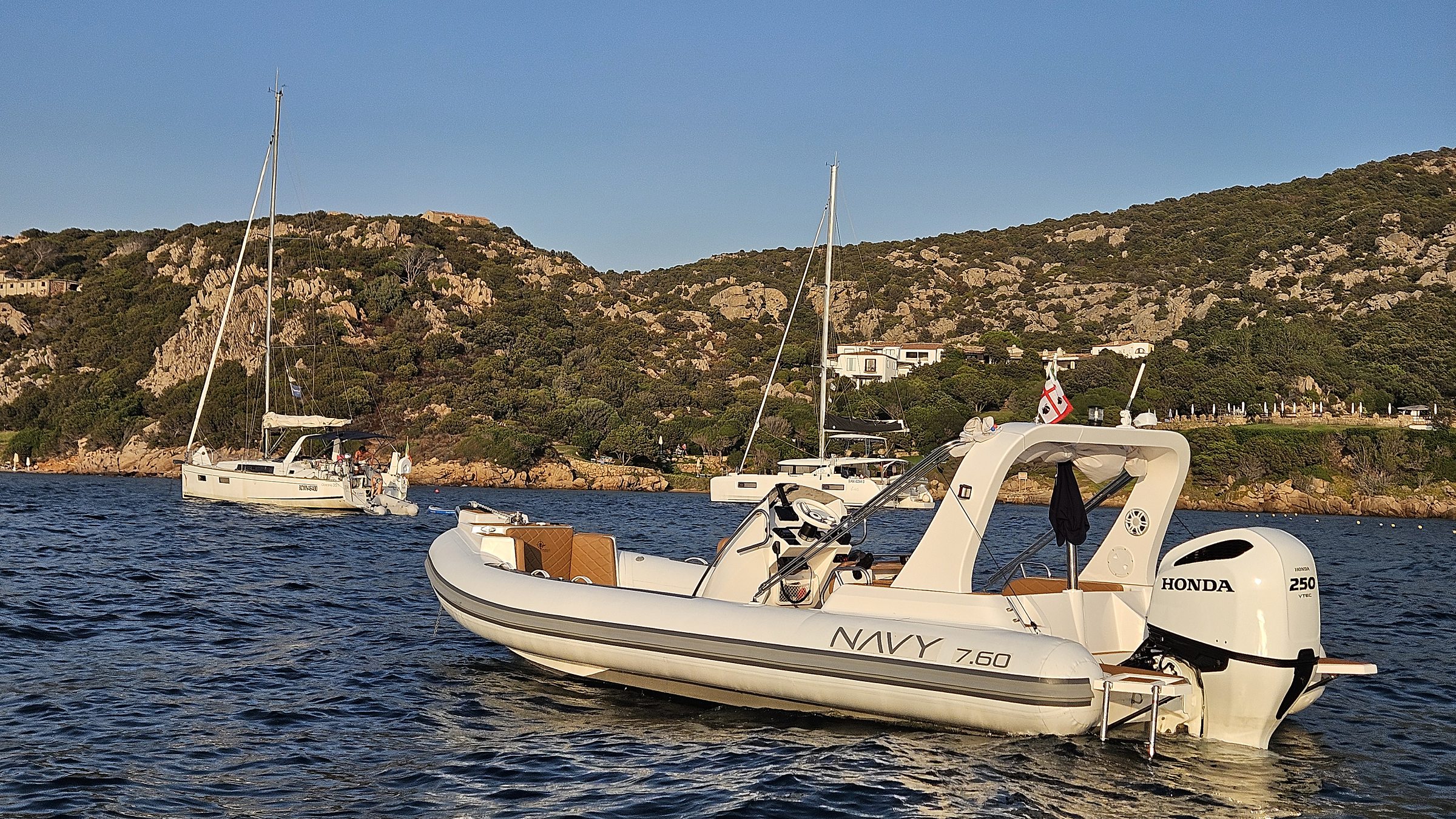
FIG. 06 — The detail that says it all: the NAVY 7.60 lettering on the tube, the white roll bar with loudspeaker and navigation light, the Honda's cowling, the stainless steel ladder. At the top of the roll bar flies the Four Moors flag.
«Quality is built centimetre by centimetre.»
— Naviglia Yachts, from the NAVY catalogue
PLATE 08 — Maintenance in four numbers, only the ones in writing
1.3mm
of ORCA fabric in the tubes from the 4.80 to the 7.60
Figure from the NAVY price list.
24
shades of EVA teak that clean with a rinse
Sample range and material sheet.
10
repairers listed by ORCA in Italy, 2 in Lazio
Network listed by the fabric manufacturer, September 2026.
5
years, at most, of extended warranty on the outboard
Yamaha, Mercury and Honda, for leisure use and on each maker's own terms.
FIG. 07 — Close-up of the dark grey raised NAVY lettering on the white tube of the 7.60, in ORCA fabric.
PLATE 09
07
The calendar, line by line
What, when, and who says so
Below you will find the maintenance of a RIB in a single table, with the source of each line beside it. Where a line refers to the manual, the right number is in your engine's handbook or in the product instructions: we do not make it up, and we do not copy it from other boats.
RIB maintenance calendar: when, what to do and which source the instruction comes from
Sources: Italian Ministerial Decree 146/2008 as amended by Ministerial Decree 133/2024; service and warranty pages of Honda, Yamaha and Mercury; publications of the maker of ORCA fabric; NAVY catalogue. Read in September 2026.
And what does all this cost? The honest answer is the one we give to anyone who asks us in writing: the running cost of a RIB varies a great deal with the type of storage and with the engine hours. A RIB that lives on its trailer and goes out a handful of times does not have the same items as one that stays on its mooring all summer and clocks up the miles every weekend. That is why we will not give you a figure that suits everyone: the real figure depends on the way you use your boat.
FIG. 08 — Wide shot: the RIB sits on the right and leaves the village, the beach and the granite wall to the left. The sky is hazy, the light warm. On the dark water the pale reflection of the hull stretches out.
PLATE 10
Questions and answers on maintenance
Care, in eight answers
These are the questions that come up most often about RIB maintenance, with the answers the regulations and the manufacturers give. One at a time: open one and the other closes.
What maintenance does a RIB need?
RIB maintenance is done in four moments. Before every outing, the basic outboard checks and a glance at the fire extinguisher; on your return, a rinse of the deck and an engine flush as the manual describes; during the season, inspecting and cleaning the tubes and, if the boat stays in the water, antifouling; at the end of the season, a service at the intervals in the engine manual.
How often should a RIB's outboard be serviced?
A RIB's outboard is serviced at the intervals in hours and months written in the owner's and maintenance manual for your model, and they change from engine to engine. Yamaha, Mercury and Honda tie their extended warranties to following those schedules; Honda, for its 5 years in Italy for leisure use, requires services within Honda's authorised network and genuine parts, and excludes hire use.
Does a RIB need antifouling?
On a RIB, antifouling is advisable if the boat stays in the water all season, whereas it is not needed if you tow it on a trailer and launch it only for outings. On a new fibreglass hull the surface has to be prepared: the data sheet for Boero's Defender primer calls for removing wax and release agents, sanding evenly and applying the first coat within 48 hours.
How do you clean the EVA teak on a RIB?
The teak-effect EVA on NAVY RIBs is cleaned with a rinse: unlike natural wood, it needs no oiling, sanding or protective treatments. The material, ethylene-vinyl acetate, stands up to ultraviolet rays, salt and the weather, stays non-slip even when wet and comes in 24 shades. Natural solid teak, 8 to 12 mm thick, is a separate option.
Can a cut RIB tube be repaired?
Yes, and cold: a cut Hypalon-neoprene tube is repaired by gluing on a patch with neoprene glue and hardener. ORCA fabric can be bought by the metre, because the manufacturer sells it precisely for repairs. Anyone who prefers to rely on a professional will find 10 repairers listed by the manufacturer in Italy, 2 of them in Lazio. Repairing a cut is maintenance; re-tubing has rules of its own.
Who can re-tube a RIB?
For a CE-marked RIB with a safety certificate, who replaces the tubes matters. Under Italian law, since 2024 art. 57, paragraph 3-bis, of Ministerial Decree 146/2008 provides that, if the replacement is not carried out by the manufacturer or by a service centre authorised by the manufacturer, the safety certificate must be validated. An unregistered natante has no safety certificate.
Does a RIB's fire extinguisher need servicing every year?
No. Under Italian law, Annex V of the recreational boating regulations, updated in 2024, states that periodic inspection of extinguishers is not required. The check consists of making sure the extinguisher is in a good state of preservation and that the pressure gauge, where fitted, sits in the charged position, the green zone. As for any safety equipment, the manufacturer's recommendations written on the product or in the accompanying documents still apply.
How much does RIB maintenance cost?
The cost of RIB maintenance varies a great deal with two things: the type of storage you choose and the engine hours you run each year. That is why there is no figure that suits everyone. The items include the engine service at the manual's intervals, antifouling if the boat stays in the water all season and cleaning the tubes following the fabric manufacturer's instructions.
Maintenance makes more sense once you know what the boat is made of. The three pages below answer the questions that come straight after: why a Hypalon-neoprene tube behaves differently from a PVC one, how a fibreglass hull is built, and who makes the fabric of NAVY tubes.
Guide written by Naviglia Yachts, a brand of Michelessi Corporation Srl · updated 25 September 2026 · the guidance comes from the regulations and the manufacturers cited and does not replace your engine's manual or the product instructions
PLATE 12 — In person
A boat is kept well when you know it
The best way to understand how much work a RIB asks of you is to look at one up close: the tube fabric, the teak-effect EVA deck, the stitching on the cushions, the stern where the engine works. Come and see a NAVY, then try it at sea. Where will you keep it, in the water all summer or on the trailer?