The name, on the stern tube
NAVY 9.50 · ORCA FABRIC BY PENNEL & FLIPO · HYPALON-NEOPRENE
On the stern section of the tube, the name. You choose the tubes from three standard colours or from the other 26 in the catalogue.
Italian brand


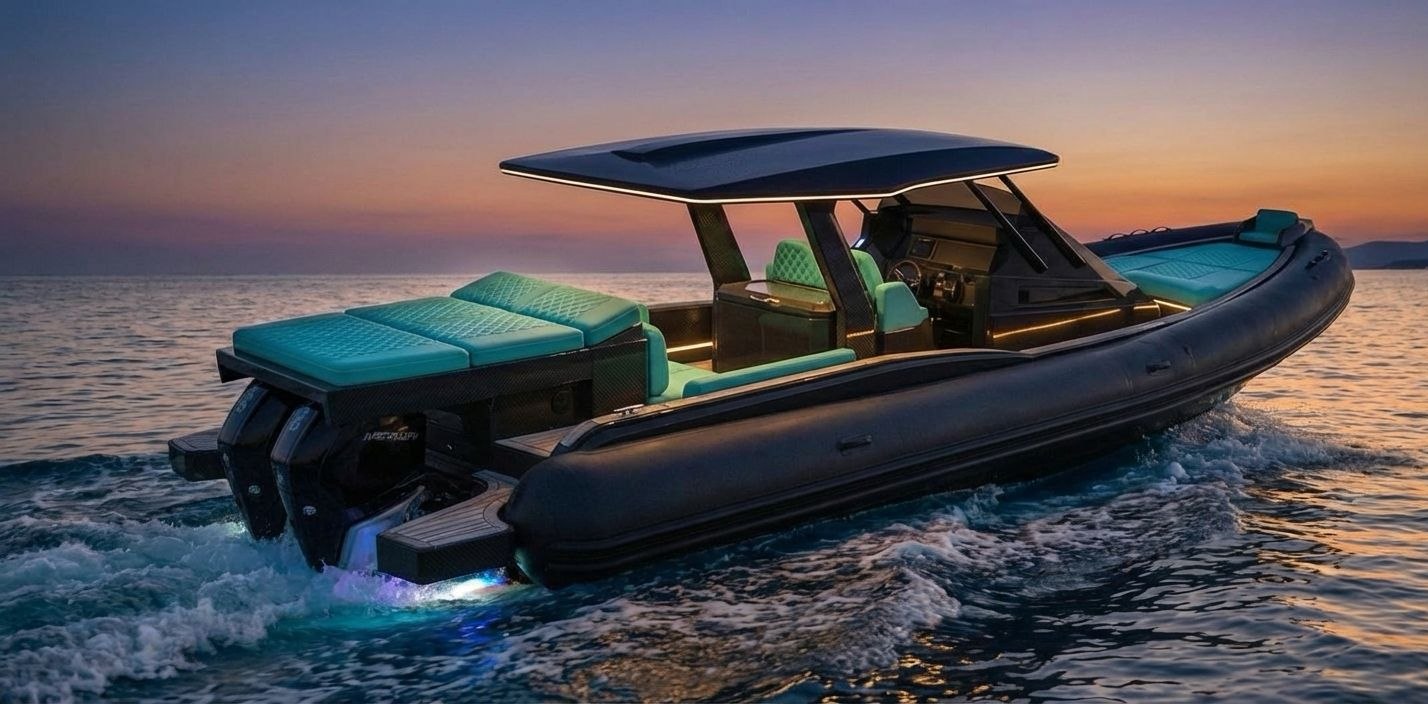
FIG. 01 — Naviglia vision, detail: the 9.50 at sunset. The sofa, the helm, the hard-top edged in light.
PLATE 02 — The 9.50 in four numbers
9.80m
length
overall
The largest of the six NAVY sizes.
3.20m
maximum
beam
Room to walk round the helm on both sides.
15
people
on board
Maximum capacity, design category B.
500litres
of fuel
for the islands
Plus 150 litres of fresh water for the shower.
PLATE 03 — How the NAVY 9.50 Cabin is laid out
Touch the brass dots: each one marks a real part of the boat. From bow to stern: the chaise longue, the cabin below deck, the helm with the galley behind it, the hard-top, the sofa, the sunpad over the engines and the swim platforms.

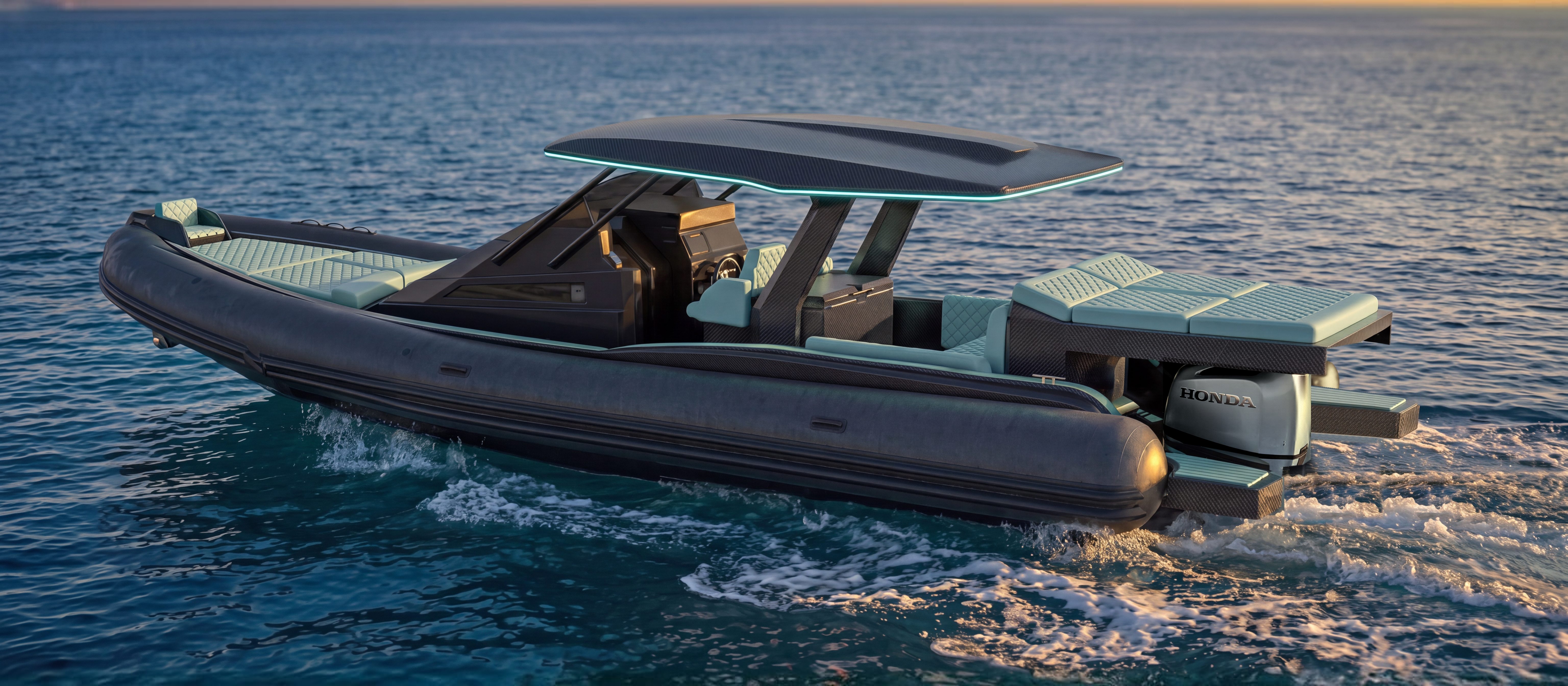
FIG. 03 — Naviglia vision: the 9.50 under way, by day. Black tubes and hull, turquoise upholstery; under the sunpad, the silver cowling of a Honda BF350.
FIG. 03 — Naviglia vision, detail: from the bow to the helm, by day.
FIG. 03 bis — Naviglia vision, detail: the stern, the sofa and the sunpad over the engines; beneath it you can see the silver cowling of a Honda BF350.
We set out in the quote, item by item, what comes with the list-price version and what comes with the Full.

PLATE 04 — NAVY 9.50 Cabin · Naviglia vision
The name, on the stern tube
NAVY 9.50 · ORCA FABRIC BY PENNEL & FLIPO · HYPALON-NEOPRENE
On the stern section of the tube, the name. You choose the tubes from three standard colours or from the other 26 in the catalogue.
The sunpad sits over the engines
A SUNBED ON TOP · TWIN OUTBOARDS BELOW
It is the piece not every boat has: a large sunpad mounted over the twin outboards. From a distance the line is as clean as that of a boat with inboard engines; beneath the sunpad the engines are still outboards, so they can be tilted up, checked and replaced without opening the hull.
You steer in front, you cook behind
A SINGLE MODULE · THE OUTDOOR GALLEY BEHIND
The helm seats and the galley are one block: whoever is at the wheel sits in front, the galley faces the cockpit, in the shade.
A hard-top measuring 2.50 by 3.70 metres
BLACK LIKE THE HULL · A LINE OF LIGHT ALONG THE EDGE
Full shade over the helm, the galley and the sofa, at any hour. In the evening the line of light draws its outline.
The chaise longue at the bow, the cabin below
BOW SUNPAD · CABIN · AIR CONDITIONING · SEPARATE HEADS
In front of the windscreen you lie in the sun; under that deck you sleep.
9.80 metres overall, 3.20 wide
CATEGORY B · UP TO 15 PEOPLE · GLOSS BLACK HULL
It is the largest of the NAVYs: wide enough for two people to walk round the helm, long enough to carry a real cabin. The rest has to be seen in person.
Come and see it in personThe tubes
ORCA Pennel & Flipo, Hypalon-neoprene (CSM/CR) · 3 standard colours, 29 in the catalogue
The tubes of the 9.50 are made of ORCA fabric by Pennel & Flipo, a French company with over 100 years of experience: Hypalon-neoprene on a polyester core, with a tensile strength of over 500 daN per 5 cm. Every tube is cut, bonded with two-component adhesives, welded two or three times at the seams that matter, pressure-tested and inspected by eye before it goes onto the hull.
As standard you choose from Notte Profonda, Pietra Bianca and Blu Navy; the other 26 colours are ordered together with the boat. On its stern section the tube carries the name: NAVY 9.50.


PLATE 06 — The hard-top · Naviglia vision
It covers the helm and the galley and reaches over the sofa: at midday there is shade for plenty of people, with no awnings to put up. The light runs along the edge, and in the evening it draws the whole outline of the roof against the sky.
Detail — The light on the edge of the roof
The 9.50's hull
So far you have seen the 9.50 from above: the roof, the sofa, the turquoise upholstery. Now go underneath, where the water does its work. This is the part you usually only see with the boat out of the water, when you can walk under it with a hand on the black fibreglass.


The first thing you notice is the V. Under the bow it is deep, as on many hulls; the difference is that it stays deep all the way to the stern, instead of opening out and flattening towards the transom. That is what decides how you go through a rough sea: the hull parts the wave and cuts through it instead of slamming down on it, and fewer jolts reach your back and your stomach.
Then the strakes: long, sharp blades running from bow towards stern on both sides of the keel. When you open the throttles they lift the hull and free it from the water sooner, turn the spray downwards and keep the boat on its line. Look at them closely: at a certain point they stop and start again further on, staggered. That is where the two steps are.
A step is a transverse notch in the bottom of the hull. The 9.50 has two: where the bottom suddenly steps up, the water lets go of the hull, and the space left behind the step fills with air drawn in from the sides. At speed the hull runs on a cushion of air: less wetted surface, less friction, more speed from the same engines and less fuel at cruising speed. That is what the sharp edges of the steps and strakes are for: they break the film of water that would otherwise cling to the bottom, and in a turn they bite into the water.
This is how the hulls of offshore boats are designed, the boats built to run in open water, and we wanted one under a cabin boat with a separate heads and a galley. One figure tells you what that means: a NAVY 9.50 with two Honda 350s has touched 65 knots.
The finish is gloss black, polished to a mirror; the volumes are symmetrical, the steps crisp. These are things you judge by eye, under the boat, before it ever touches the water. The Naviglia visions in this chapter are drawn from photographs of the real hull; the three-dimensional scan, which you can turn below, was taken on the hull itself. The boat can be seen in person, by appointment: ask us to show you the hull up close.
The scan of the real hull
SCAN OF THE HULL · TO TURN · FROM BELOW · FROM THE SIDE
What follows is not a photograph: it is the three-dimensional scan of the real hull, taken on the hull itself. Without the sea, the stands or the deck, only the shape is left: the V, the strakes running towards the bow, the steps where the strakes break. Press “Explore the scanned hull” and turn it as if you were walking underneath; then the two still views, from below and from the side.

IN THE ROUND — Scan of the real hull of the NAVY 9.50 · 17 September 2026


PLATE 08 — At the helm
Under the hard-top, the helm
HELM SEATS IN FRONT · OUTDOOR GALLEY BEHIND · ONE BLOCK
From here you see everything: the bow ahead, the cockpit behind. The turquoise seats and the gloss black galley unit form a single module, with no lone seats in the middle of the cockpit: whoever is making lunch works in the shade, facing the cockpit, without going below.
To the left of the dashboard, the sliding door
GLOSS BLACK · SLIDES ASIDE
It is not a locker: it is the way into the cabin. It slides into the console, right beside whoever is at the wheel, and the way through stays clear.
Beyond the door, the cabin
WARM LIGHT · THE TURQUOISE BED AT THE END
In the evening you go down with your hands full, and slide the door shut behind you.
Below deck · Naviglia visions
A cabin RIB changes the way you use the sea: you do not head back because it is getting dark, you head back when you feel like it. Under the bow of the 9.50 there is a sleeping cabin, with air conditioning, and a separate heads.


From the sliding door to the left of the dashboard you go down into the cabin. The bed fills the bow, with turquoise cushions; at night you close everything and switch on the air conditioning. The heads is a separate compartment with its own door: the veined black counter with the basin, the WC with the black-water holding tank, the on-board shower drawing on 150 litres of fresh water. You find out what it is really like by stepping aboard.
“Because true luxury is not being seen, it is feeling.”
Yard notebook · photographs
The images at sunset are visions: they show the 9.50 as it was designed. These four are photographs, taken while the boat is being fitted out: details shot close up, as in a notebook. The boat exists, and you can see it in person, by appointment.


FIG. 12 — Photographs from the yard, details: the cabin, the side deck, the cockpit in the evening and the bow of the boat being fitted out. These are work-in-progress photographs: the colour of the tubes is yours to choose.
The decking is teak-effect EVA: grey, with turquoise stripes in the same shade as the upholstery. Soft underfoot, non-slip when wet. You find it on deck and in the cabin well, between the two wings of the V-berth.
In the evening the blue courtesy lights come on, in the decking and under the gunwales: they mark the way without dazzling. You will see the final finishes in person.
The NAVY 9.50 Cabin data sheet
The table holds the dimensions and the equipment we can put in writing today. The dry weight and the tube diameter are not yet confirmed for this version, so we do not write them: better a row left out than a number made up. We send you the full data sheet with the quote.

Overall9.80 m
Price list
from €86,900 + VAT · engine not included€106,018.00 incl. 22% Italian VATData sheet entries 22
| Length overall | 9.80 m |
|---|---|
| Beam | 3.20 m |
| People on board | 15 maximum capacity |
| CE design category | Bwind up to force 8, waves up to 4 m |
| Engines | twin outboardsyou choose the make: Honda, Yamaha or Mercury |
| Engines fitted so far | from 2 × Honda 250 to 2 × Honda 350twin outboards, for two different customers |
| Power | on quotationwe decide it together, for your route and your load |
| Fuel tank | 500 litres |
| Fresh-water tank | 150 litresfor the on-board shower |
| Hard-top | 2.50 by 3.70 m |
| Below deck | interior cabin with berths and a separate heads |
|---|---|
| Cabin | V-berth, air conditioningentered through the sliding door to the left of the dashboard |
| Heads | separate, with a black-water holding tankon-board shower |
| Helm | single module with the outdoor galley behindthe galley faces the cockpit |
| Aft | large sunpad over the outboard enginesswim platforms on both sides |
| Forward | chaise longue and sunpad |
| Tube fabric | ORCA Pennel & Flipo, Hypalon-neoprene (CSM/CR) |
| Standard tube colours | Pietra Bianca, Notte Profonda, Blu Navyanother 26 ORCA colours on request |
| Fibreglass | white or blackhull, deck, stern platforms and console, with increased laminate thickness |
| Upholstery | 14 colours in the catalogueturquoise on the boat being fitted out |
| Decking | teak-effect EVA, 24 shadessolid natural teak, 8 to 12 mm, as an option |
| Warranty | Up to 15 years' warranty |
Data sheet being updated — the missing figures are available on request.
Source Naviglia Yachts data sheet
The NAVY 9.50 Cabin gallery
Touch an image to open it full screen, then move through them with the arrows or with your finger. Under each card, “The story” opens the long text. The Naviglia visions show the 9.50 as it was designed; the photographs from the yard show the boat being fitted out.
FIG. 14 — Naviglia vision, detail: the 9.50 at dusk.
The sky turns from orange to violet and the sea reflects it. The black hard-top carries its line of light; beneath it are the turquoise helm seats and sofa, and the black tube runs all the way to the bow, where the chaise longue is waiting.
It is a detail of the second vision at sunset: the 9.50 as it was designed, gloss black, with turquoise upholstery. Under the foredeck are the cabin and the heads. In the evening the lights on board are enough to pick it out from the quay.
FIG. 15 — Naviglia vision: the forward cabin.
From the door you step into the forward cabin: the bed fills the whole point, with turquoise cushions divided into panels and a backrest that runs along the sides. The pale ceiling is lined with strips of warm light; on the left, a small shelf.
You reach it through the sliding door to the left of the dashboard. It is the reason people choose a cabin boat: a door to close, a real bed, air conditioning for August nights at anchor. This is a vision of the fit-out: you will see the final finish of the panels in person, and in the photograph from the yard they are white fibreglass, with the V-berth following the bow.
FIG. 16 — Naviglia vision: the 9.50 by day, on the open sea.
Open sea, clear sky: the 9.50 runs with its bow to the left and leaves a white wake. Black tubes and hull, the black hard-top poised on its raked pillars and the turquoise of the smooth cushions appearing three times: the bow sunpad, the seats under the roof, the large stern sunpad. Under the stern sunpad, between the two wood-coloured swim platforms, the silver cowling of a Honda BF350.
By day the 9.50 shows its proportions: 9.80 metres overall by 3.20 wide, with the 2.50 by 3.70 metre hard-top floating over the helm and the cockpit. In this vision the upholstery is smooth; in the sunset ones it is diamond-quilted: two finishes of the same idea, and you choose the one for your 9.50 from the samples. From bow to stern you can read the chaise longue, the windscreen, the helm seats with the outdoor galley behind them, the sofa and the sunpad over the engines.
FIG. 17 — Naviglia vision: the separate heads.
Seen from above, the heads: a black counter veined with white, with the basin carved from the same block and dark taps. Below, black doors with the same veining; behind, the full-width mirror framed by a strip of turquoise light. Cream walls, a line of warm light at the base and, in the foreground, the WC with its black lid.
The heads of the 9.50 is a separate compartment, with its own door: the answer for anyone looking for a RIB with a cabin and a heads, not a cubbyhole squeezed in behind the console. The veined black counter with its carved basin and the line of turquoise light round the mirror are those of this vision. The WC has a black-water holding tank, which at anchor and in harbour settles any argument; the on-board shower draws on a 150-litre fresh-water tank.
FIG. 18 — Naviglia vision: the 9.50 at dawn, with the silver cowling of a Honda BF350 under the sunpad.
First light on the sea: a line of gold on the horizon and the water still blue. The 9.50, seen slightly from above, carries a line of turquoise light along the rim of the hard-top; the cushions, in a lighter turquoise, are diamond-quilted, from the bow sunpad to the stern one; under the stern sunpad you can see the silver cowling of a Honda BF350.
Dawn belongs to those who slept on board. Under the foredeck is the cabin, with the bed and the air conditioning; next to it, the separate heads. In this vision the line of light on the rim of the hard-top is turquoise and the quilted upholstery has a lighter tone: it is a colour variant, not another boat. With 500 litres of fuel and 150 litres of fresh water, setting off at dawn means you can come back whenever you like.
FIG. 19 — Photograph from the yard, detail: the cabin of the boat being fitted out.
The forward cabin, clean and ready: the V-berth fills the point of the hull with turquoise leatherette cushions and a backrest that follows the sides; in the middle, the white fibreglass well with grey decking striped in turquoise. White walls and ceiling, two portholes high up in the corners.
This is not a vision: it is the cabin of the boat being fitted out, photographed just as it is. The turquoise leatherette V-berth follows the sides right into the point; in the middle, the white fibreglass well carries the same grey decking with turquoise stripes you find on deck. Walls and ceiling are white and glossy, and two portholes let the light in. It is the simplest proof that the 9.50 exists: you will see the rest when you step aboard.
FIG. 20 — Naviglia vision: the dashboard, with the sliding door drawn back.
At the helm, with the sliding door drawn back. To the left of the dashboard is the way into the cabin: the gloss black panel has slid into the console, and only its edge and the recessed pull are left in view. Beyond are the steps down, and below you glimpse the turquoise bed. In the middle, the dashboard with the wheel; behind the helm seats, the gloss black unit of the outdoor galley, facing the cockpit.
Seats and galley are a single block: whoever is at the wheel has everything in front, whoever is making lunch works behind, in the shade of the hard-top. Underfoot, the grey decking with turquoise stripes that you find again in the photographs from the yard.
FIG. 21 — Naviglia vision, detail: the 9.50 by day, from the bow to the hard-top.
A detail from the same clear day: the bow riding high above the sea with the turquoise chaise longue and sunpad, the black console with its windscreen, the hard-top as slim as a wing on its raked pillars and, beneath it, the turquoise helm seats and sofa. The black of the tubes runs the whole length of the frame.
It is the right crop for reading the forward half: the high line of the tubes, the chaise longue, the console with the windscreen and the slim roof on its raked pillars. At sea the 9.50 is in design category B, the one for boats designed for winds up to and including force 8 and a significant wave height up to and including 4 metres, and it carries up to 15 people.
FIG. 22 — Photograph from the yard, detail: decking, steps and hull.
The side passage towards the bow, up close: the grey teak-effect EVA decking with its turquoise stripes, the shaped steps down into the cockpit, the gloss black hull reflecting the sky. On the gunwale a stainless steel pop-up cleat, next to it the dark tube; at the top, the grab rail.
It is the detail you notice straight away in person: the teak-effect EVA decking, grey, with turquoise stripes in the same shade as the upholstery. It is soft underfoot and non-slip when wet. Solid natural teak, 8 to 12 millimetres thick, remains an option for those who want real wood.
FIG. 23 — Naviglia vision: the 9.50 under way at dusk.
The sky shifts from violet to orange and the 9.50 cuts through the water with its white wake behind. The line of light runs along the hard-top, the quilted turquoise sunpad sits over the engines and, on the tube, you can read the name: NAVY 9.50.
It is the sunset scene in large format: it lets you look closely at what gets lost in the small images. In the cockpit, the single-module helm with the galley behind; along the gunwales, the line of turquoise light; at the bow, the chaise longue in front of the windscreen. Higher up this page, it is the image you travel along from stern to bow, one stop at a time.
FIG. 24 — Photograph from the yard, detail: the courtesy lights switched on.
It is evening, during the fit-out: from above you look down into the cockpit. The blue lights in the decking and under the gunwales trace the walkways; at the top, the black seat module with its turquoise cushion and the stainless steel grab rail; at the bottom, a dark slatted panel with a flush stainless steel cap and, beside it, a gloss black locker.
It is a work-in-progress photograph, taken close up, but it says something the visions cannot: the lights are already there, and they work. They mark the walkways without dazzling, just enough to move about on board once the sun has gone down.
FIG. 25 — Photograph from the yard, detail: the bow of the boat being fitted out, with grey work-in-progress tubes: the colour is yours to choose.
From above, during the fit-out: the turquoise bow sunpad with its backrest, the gloss black coachroof with the windscreen, the start of the hard-top and the pale side decks running forward.
It is a work-in-progress photograph, taken close up: the sunpad of the chaise longue you see in the visions is already fitted to the boat here. Under that deck are the cabin and the heads; you go down to them through the sliding door to the left of the dashboard.
FIG. 26 — Naviglia vision: the stern, with the boat at rest.
At rest on the flat evening water, the stern of the 9.50 seen head-on. The quilted sunpad covers the stern over the twin engines; on either side, the swim platforms, in this vision covered in grey EVA with turquoise stripes; under the hull, in the vision, the lights set the water glowing.
From here you can also see how you climb aboard from the sea: from the swim platforms, on either side of the engines. In the background, under the hard-top, the helm seats and the line of light on the roof.
FIG. 27 — Naviglia vision: the hard-top from the cockpit.
The hard-top seen from the cockpit, in the evening. It measures 2.50 metres wide by 3.70 long: it covers the helm and the galley and reaches over the sofa.
In this vision the roof is gloss black, with warm light along the edge and the pillars raked backwards. Below, along the gunwales and in the decking, a line of turquoise light marks the walkways. At midday it gives shade to everyone; in the evening it is the outline that makes the boat recognisable from afar.
FIG. 28 — Naviglia vision: NAVY 9.50, at the stern.
The name, up close: NAVY 9.50, in white letters on the stern section of the tube. Above it you see the turquoise sofa and sunpad, in full daylight.
The tubes are made of ORCA fabric by Pennel & Flipo, Hypalon-neoprene: three standard colours, Notte Profonda, Pietra Bianca and Blu Navy, and another 26 on request.
Naviglia visions and photographs from the yard NAVY 9.50 Cabin
PLATE 13 — What the NAVY 9.50 Cabin costs
The price of the RIB does not include the engine, because we do not impose one on you: make and power are chosen together, and we quote them with the boat. That way you have the final figure in front of you before you decide.
In person
The cabin with its berths and the separate heads has to be seen from the inside.
Book your visitBook a sea trialWrite to us on WhatsApp
Ask for a quote · All the NAVY prices · Financing and marine leasing
| Price-list item | Price + VAT |
|---|---|
| Option to change the colour of the tubes | €1,633One of the 26 ORCA colours outside the three standard ones, ordered together with the boat. |
| Four extra speakers for the on-board player | €2,237Six speakers in all. |
| Boat trailer | €12,228It is the trailer item on the NAVY price list: we check its size and type approval for the 9.50 together in the quote. On the road the 9.50 travels as an abnormal load. |
The colours of your NAVY 9.50 Cabin
Tubes, fibreglass, decking and upholstery: every swatch is the real sample from the catalogue, with its name and its code. Touch a swatch and the lens shows it to you up close; the “Your choice” line keeps count and carries it into the quote.
We started from black fibreglass and the light grey decking with the aqua-green seam, as on the boat being fitted out; the colour of the tubes is yours to choose, from the three standard ones and the others in the catalogue. The turquoise upholstery you see in the images is the colour of the boat being fitted out and is not among the 14 in the sample book: if you want it, write it in your quote request.
The helmNaviglia vision · black fibreglass, light grey decking with aqua-green seams, turquoise upholstery
Your choice
Catalogue sample book NAVY series
On the boat being fitted out turquoise upholstery
The brass dot marks the standard colours.
T-09 — teak-effect decking: light grey plank, aqua-green seam. The sample book gives a code, not a name: in the showroom you touch it with your own hands.
Only the colour codes travel in the link, none of your data.
These colours, seen in person, are another thing: the real samples are there to be touched.
PLATE 15 — Engines for the NAVY 9.50 Cabin
The 9.50 carries twin outboards at the stern, under the sunpad. The engines we have fitted range from two Honda 250s, for one customer, to two Honda 350s, for another. You choose the make, Honda, Yamaha or Mercury, and we decide the power together in your quote.

Outboard · four-stroke
Mercury on the NAVYs
Outboard · four-stroke
Honda on the NAVYs
Outboard · four-stroke
Yamaha on the NAVYsThe engine is not included in the list price and is quoted together with the boat. If you already have engines, tell us: we check whether they suit the model from their rating-plate data. We choose the power together, for your route and your load.
PLATE 16 — Who the 9.50 is for
Those who want a cabin boat do not want an open boat: they want a door to close, a bed and a proper heads, without giving up the sun and the cockpit of a RIB.
The 9.50 is the only NAVY with a cabin; the 7.60 is an open boat, and for many people it is the right size. The two lengths are drawn to scale; the table keeps only the confirmed figures for each. Engines and prices are in the two cards below.
The two lengths, to scale
| Item | 7.60 | 9.50 |
|---|---|---|
| Length | 7.60 m | 9.80 m |
| Beam | 2.89 m | 3.20 m |
| People | 15 | 15 |
| Fuel | 280 l | 500 l |
| Below deck | open | cabin and heads |
PLATE 17 — See also · the two largest NAVYs
01 / 02

7.60 m overall · 15 people · 200/250 hp recommended · category C
7.60 m RIB, up to 15 people, single outboard up to 350 hp or twin engines.
from €33,000 + VAT · engine not included€40,260.00 incl. 22% Italian VAT
Discover the 7.609.80 m overall · 15 people · twin outboards, power on quotation · category B
Cabin RIB, 9.80 m overall and 3.20 m beam, design category B, up to 15 people, twin outboards.
from €86,900 + VAT · engine not included€106,018.00 incl. 22% Italian VAT
Ask for a quoteQuestions about the 9.50
These are the questions that reach our office when someone searches for “cabin RIB”, “RIB with cabin and heads” or “9 metre RIB price”, with the answers we give when you ask us in person.
The NAVY 9.50 Cabin starts from €86,900 + VAT, engine not included, which is €106,018.00 with 22% VAT. The Full version costs €120,000 + VAT, engine not included, which is €146,400.00 including VAT. The engine is quoted separately, together with the boat, and the cost of transport is written in the quote: that way you have the final figure in front of you.
The prices are net: they exclude VAT and the engines, which are chosen separately according to how you plan to use the boat. The 9.50 can be bought with or without engines; we quote twin Honda, Yamaha or Mercury outboards together with the boat, with several power options.
Yes. The NAVY 9.50 Cabin has an interior cabin with berths and a separate heads: an enclosed compartment with its own door, the WC with a black-water holding tank, the basin and the on-board shower, which draws on a 150-litre fresh-water tank.
In the cabin, under the foredeck. You reach it through the sliding door to the left of the dashboard, next to the helmsman. The bed of the NAVY 9.50 Cabin is a V-berth that follows the shape of the bow; the cabin has air conditioning. Next to it is the separate heads. You can see what it looks like in the images on this page and, better still, in person.
Yes, and it is in the open air. On the NAVY 9.50 Cabin the helm is a single module: the seats in front, the outdoor galley behind, a gloss black unit facing the cockpit. You cook in the shade of the hard-top, without going below.
The NAVY 9.50 Cabin has twin outboards at the stern, under the sunpad. So far we have fitted two power levels: two Honda 250s for one customer, two Honda BF350s, the new 350 hp eight-cylinder engines, for another. You choose the make from Honda, Yamaha and Mercury, the outboards we fit to the NAVYs; we decide the power together with the quote.
Because an outboard can be tilted up, checked and replaced without opening the hull: simple maintenance and more space on board. The large stern sunpad sits over the two engines and gives the NAVY 9.50 Cabin the clean line of an inboard boat, without giving up anything of the outboard.
Yes, always: the licence depends on the engine, and within 6 miles of the coast you can do without one only with engines up to 30 kW (40.8 hp), within the cylinder-capacity limits set by law. With twin 350 hp outboards you are well beyond that. If you are looking for a NAVY you can drive without a licence, we recommend the 40 hp engine on models up to the 6-metre.
The NAVY 9.50 Cabin is 3.20 m wide and exceeds the 2.55 m gauge set by the Italian Highway Code: on the road it travels as an abnormal load, with an authorisation from the authority that owns the road. The price list includes a boat trailer, €12,228 + VAT; we organise transport to your port ourselves and put it in writing in the quote.
Category B covers boats designed for winds up to and including force 8 and a significant wave height up to and including 4 metres, under the European directive on recreational craft. With 15 people on board and 500 litres of fuel, the NAVY 9.50 Cabin is designed to go out even when the sea is not flat.
Every NAVY 9.50 Cabin is built to order: we fix the lead times together when the order is confirmed, in writing, without promising dates we cannot keep. You can see it in person: book your visit and we will fix the day together. The sea trial can be booked too: we fix the day and the arrangements together.
In part. The sunset, daytime, cabin and heads images are Naviglia visions: they show the NAVY 9.50 Cabin as it was designed. Those marked “photograph from the yard” are real photographs of the boat being fitted out. The hull visions come from photographs of the real hull, the close-up of the steps from a hull in white gelcoat; the views marked “scan” are the three-dimensional scan of the hull. We will show you the boat in person.


PLATE 19 — The NAVY 9.50 Cabin, in person
The images can take you this far. The tube under your fingers, the real colours of the samples, the space on board: those you see in person. Which day suits you?
Book your visitBook a sea trialAsk for a quote
Call +39 380 173 0961Message us on WhatsAppEmail us
Naviglia Yachts — Aprilia (LT), Italy · 380 173 0961