«Hypalon» is a trade name: the fabric of top-end RIBs is a CSM/CR composite, a synthetic rubber coated onto a polyester fabric, and it is joined by gluing. PVC is a thermoplastic: it is high-frequency welded, costs less and weighs less, but suffers more from sun and heat and is harder to repair. NAVY tubes are made of ORCA fabric by Pennel & Flipo, Hypalon-neoprene on a polyester core; for the 1.3 mm fabric, from the 4.80 to the 7.60, our catalogue states a tensile strength of over 500 daN per 5 cm.
CSM/CR versus PVC · gluing versus welding · 1.3 mm from the 4.80 to the 7.60 · updated 25 September 2026
When two RIBs of the same size carry very different prices, the first question to ask is what their tubes are made of. There are two possible answers, and the maker of the fabric we fit sums them up in one line: PVC is a thermoplastic, while Hypalon-neoprene is a synthetic rubber. Everything else, that is how they age in the sun, how they are repaired, how much they weigh and how much they cost, follows from this difference in material.
The name causes confusion. Hypalon was the trade name under which DuPont sold CSM, chlorosulphonated polyethylene, introduced in the 1950s; DuPont stopped producing it in 2010, and since then, in the world of RIBs, «Hypalon» has become the common name for CSM fabric. Today's top-end fabric is a CSM/CR composite: on the outside the CSM, which holds its colour and stands up to the sun, on the inside the CR, that is neoprene, which keeps air and water where they belong. That is why people speak of Hypalon-neoprene. PVC, on the other hand, is a fabric coated with a plastic that melts when heated: it is the property that allows it to be welded.
FIG. 01 — Naviglia vision: how a black Hypalon-neoprene fabric looks close up, with a glued seam band laid over it. On the outside is the CSM, the layer that takes the sun.
PLATE 03 — Inside the tube · real photograph
Four layers in one fabric
Outside, the CSM that stands up to the sun
OUTER LAYER · WEATHER, CHEMICALS, ABRASION
It is the layer you see and touch. The manufacturer describes it as the rubber with the best resistance to ultraviolet rays and to ageing, for boats that live permanently in the sun, the salt and the weather.
Then the neoprene that holds it together
CR INTERLAYER · BOND BETWEEN RUBBER AND FABRIC
Beneath the skin lies a thin film of neoprene: its job is to bond the outer rubber to the fabric underneath, so that the layers do not come apart with folding, knocks and the passing years.
At the centre, high-tenacity polyester
TENSILE STRENGTH OVER 500 daN PER 5 cm · 1.3 mm FABRIC · FROM OUR CATALOGUE
It is the fabric that carries the loads: the air pressure, the weight of whoever sits on the tube, the snatching of the lines at the mooring. For the 1.3 mm fabric of NAVY RIBs, from the 4.80 to the 7.60, our catalogue states a tensile strength of over 500 daN for every 5 cm strip.
Inside, the neoprene that holds the air
INNER CR LAYER · AIRTIGHT AND WATERTIGHT
The last layer faces the inside of the tube and has one job only: to let neither air nor water through. A PVC fabric does the same job with a different material, and the pieces are joined in a different way.
A tube is not born in one piece: it is built by joining cut panels of fabric. This is where the two materials part ways. PVC, being a thermoplastic, is high-frequency welded: the heat melts the two surfaces and turns them into one. Hypalon-neoprene, being a rubber, does not melt: it is joined by gluing, with two-part adhesives, overlapping the edges of the fabric. It is handwork, and in return it gives seams that the fabric maker describes as durable, airtight and watertight over time.
There is also a third, lesser-known family: polyurethane-coated fabrics, which the same manufacturer offers for workboats and which can be welded as well as glued. On leisure RIBs the real choice, the one you find in price lists, remains between the two columns of the table below. The entries are the ones the fabric maker lines up in its frequently asked questions in Italian, with the advantages and the drawbacks of both materials, including those that are awkward for anyone selling Hypalon.
Hypalon-neoprene and PVC tubes compared, point by point, according to the maker of ORCA fabric
What matters
Hypalon-neoprene (CSM/CR)
PVC
What it is
Synthetic rubberCSM outside, neoprene inside, on a polyester fabric
Thermoplasticcoated onto a fabric
How it is joined
By gluingtwo-part adhesives, overlapping edges
By weldinghigh frequency
Sun and ultraviolet
ResistantCSM is the rubber chosen for boats that are always in the sun
More sensitiveit ages under ultraviolet rays
Heat and extreme temperatures
Resistantthe manufacturer also recommends it for tropical regions
More sensitive to heat
Fuels and oils
Resistant to hydrocarbons
Not listed among its advantages by the manufacturer
Folding, knocks, chafing
Resists abrasion and chafing
Not recommended for intensive use
Repairs
Easycold gluing
More difficult
Weight
Heavier
Lighter
Purchase price
Higher
Lower
Resale value
Higher
Lower
Source: frequently asked questions of the shop run by Pennel & Flipo, the maker of ORCA fabric, in Italian, and the manufacturer's sheet on the properties of the fabric; the high-frequency welding of PVC is a technical fact of the material. Read in September 2026.
FIG. 02 — The raised white letters run along the anthracite tube, sharp only where they need to be. Behind them, out of focus, the console and a full sky. The light grey rubbing strake crosses the frame like a waterline. The raised rubbing strake takes the knocks in place of the fabric.
PLATE 05
The four points that weigh most
Sun, glue, kilos, euros
These are the points anyone buying a RIB puts on the scales, even without realising it. We take them one at a time, with what can truly be said and without invented numbers.
FIG. 03 — White raised 7.60 NAVY lettering on the anthracite tube, black roll bar in the background.
03
Sun and heat
Where you see the difference
A RIB spends a few hours on the water; the rest of the season it sits still, on its mooring, on the trailer or in the boatyard, with the July sun beating down on it. The tube is the part that pays first for this life. The fabric maker lists sensitivity to ultraviolet rays, and the ageing that follows, among the drawbacks of PVC; among the advantages of Hypalon-neoprene it lists resistance to ultraviolet and to extreme temperatures, to the point of recommending it for tropical regions too. On the Tyrrhenian in summer, with a dark tube exposed for hours, this is the point that counts most.
FIG. 04 — White tube of the NAVY 7.60 with grab handles, quilted grey sundeck and teak-effect deck.
04
Repairs
A cut is not the end
A knock against the quay or a rock misjudged can cut any tube. The difference lies in what happens next. Hypalon-neoprene is repaired cold, with neoprene glue and hardener, and the fabric can be bought by the metre: the manufacturer's shop sells its tube fabric by the linear metre, precisely for repairing and customising. In Italy the manufacturer lists a network of 10 repairers of its fabric, 2 of them in Lazio. Of PVC, the same manufacturer writes that repairs are more difficult.
FIG. 05 — Aft half of the NAVY 7.60 with roll bar and lettering, white houses and granite behind.
05
Weight and price
What PVC does better
Let us say it plainly: PVC wins on two points, and the maker of the Hypalon fabric is the first to write it. It weighs less and it costs less to buy. For a small tender kept on board a larger boat, or for a RIB used a few weeks a year, these can be serious arguments. On price, the thing to look at is not only the purchase: the same manufacturer lists resale value among the advantages of Hypalon and among the drawbacks of PVC.
PLATE 06
06
PLATE 06 — Chapter 06 · How long it lasts
Why we do not give you a number of years
Exposure · mooring · use · care
Online you will find blunt comparisons, along the lines of «so many years for Hypalon, half that for PVC». We do not write them, for a simple reason: we have not found a manufacturer's technical datasheet that compares the two lifespans with the same test for both. The life of a tube depends on how many hours it spends in the sun, where the boat sleeps, how hard it works and how it is looked after. Two identical RIBs, one in covered storage and one on a mooring all year round, age in different ways.
The maker of our fabric states that a well-maintained Hypalon tube can last up to 25 years, and in 2016 it documented a RIB with its original 1991 tubes in ORCA fabric still in good order. That is the manufacturer's own statement, and we report it as such: it is not a promise of ours. What we can say is that the material beneath the NAVY lettering is the one the manufacturer recommends for boats that are always exposed to the sun.
FIG. 06 — An expanse of tobacco-coloured diamonds, divided into three cushions by the dark lines of the seams. On the left, the white of the tube, with a grab handle.
Detail — 01 · The white tube beside the sunpad · real photograph
«Because the sea makes no allowances, and neither do we.»
— Naviglia Yachts, from the NAVY catalogue
PLATE 08 — The figures of the fabric on NAVY RIBs, only the written ones
1.3mm
of fabric in the tubes from the 4.80 to the 7.60
Price-list figure, the same on 5 models.
52cm
of tube diameter on the 6.00 and the 7.60
Price-list figure: 48 cm on the 4.80, 50 on the 5.50.
500daN
and more of tensile strength per 5 cm of fabric
From our catalogue, for the 1.3 mm fabric from the 4.80 to the 7.60.
29
fabric colours in the NAVY sample book
3 as standard, the others on request.
FIG. 07 — The NAVY 6.00 lettering fills the foreground on the white tube, next to a grey grab handle. In the background, out of focus, the console with the wheel and a clear sky.
PLATE 09
07
On NAVY RIBs
What goes on a NAVY
On NAVY RIBs we do not ask you to choose between the two materials: the choice has been made upstream. Every tube in the range is made of ORCA fabric by Pennel & Flipo, a French company with over 100 years of experience in rubber-coated fabrics, in Hypalon-neoprene on a polyester core. There is no NAVY with PVC tubes, at any size or at any price. What changes with the boat is the thickness of the fabric and the diameter of the tube, and the table tells you exactly what you will find on each model, with the figures from the price list.
The fabric arrives in rolls; the tube is built in the yard. It is cut by hand or by computer-guided cutting, the parts are joined with two-part adhesives, the critical seams are reinforced by hand with double or triple passes, and every finished tube goes through a pressure test and a visual inspection before it is fitted to the fibreglass hull. There are 3 standard colours, Deep Night, White Stone and Navy Blue, out of 29 in the catalogue.
Tube fabric, thickness and diameter on every NAVY model, according to the price list
Source: public price list and NAVY model sheets. The thickness is that of the fabric stated in the price list.
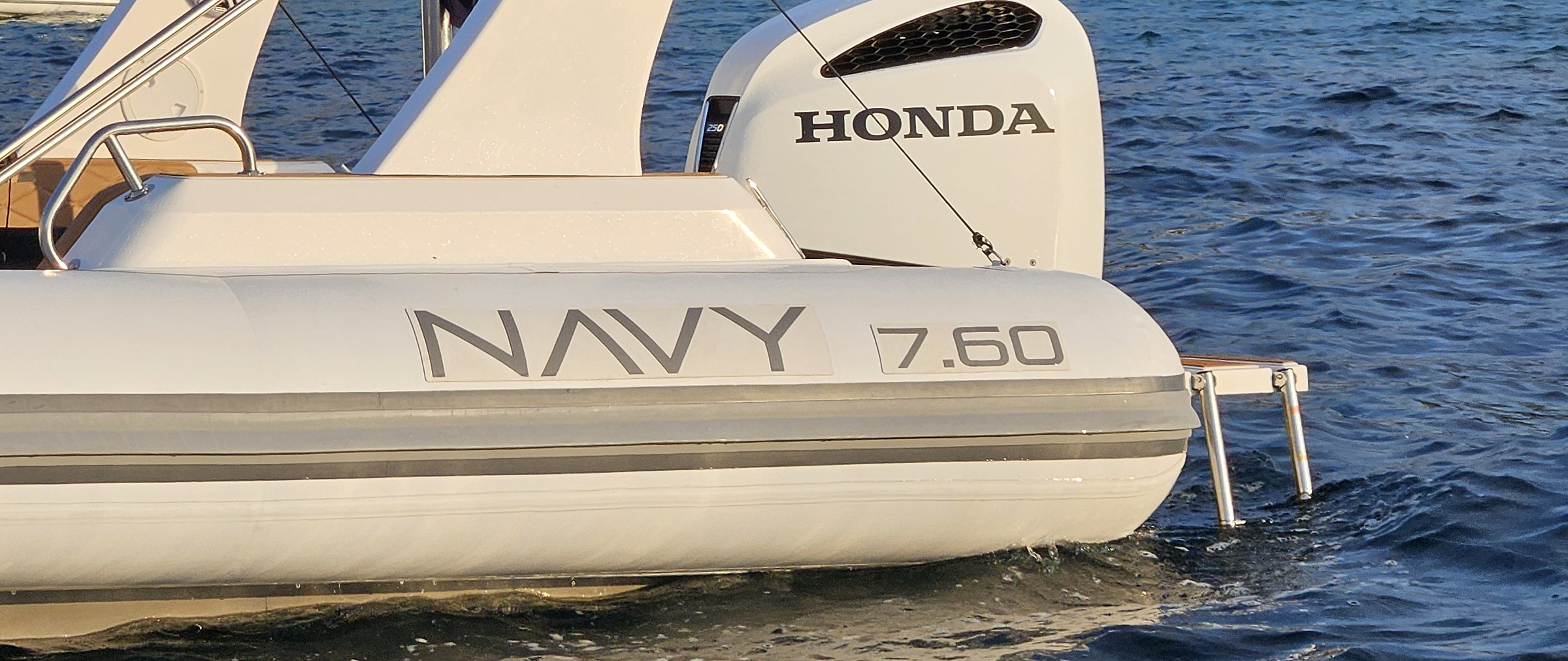
FIG. 08 — Full late-afternoon light: the 7.60 sits in the bottom right-hand corner, with the Honda 250 and the NAVY 7.60 lettering clearly legible. Behind, a hill of scrub and pale rock and two sailing boats at anchor. The water is cobalt blue, barely ruffled.
PLATE 10
08
When the tubes are replaced
Who replaces the tubes matters
There is one point worth knowing before buying a RIB in Italy, and since 2024 it has been written into a decree. Under Italian law, Ministerial Decree 133 of 17 September 2024 added paragraph 3-bis to the Italian recreational boating regulations (art. 57 of Ministerial Decree 146/2008): if the tubes of an inflatable craft are replaced by someone who is neither the manufacturer nor a service centre authorised by the manufacturer, then for a CE-marked craft the procedure for validating the safety certificate laid down in art. 51, paragraph 3, applies.
In plain terms: on craft that hold a safety certificate, that is, registered craft, having the tubes replaced outside the builder's own chain is not a private matter, but opens an inspection. An unregistered natante has no safety certificate. In both cases the same advice holds: on the day a tube needs replacing, first ask whoever sold you the boat what fabric its tubes are made of. On NAVY RIBs the answer is written in the table above.
FIG. 09 — The whole hull, in three-quarter view from the bow, with the sun now low and striking it from the side. The water around it is a dark sheet full of copper reflections. In the background, the beach, the white houses and the granite ridge.
PLATE 11
Questions and answers on tubes
Tubes, in eight answers
These are the questions worth asking about the tubes when comparing two RIBs, with the answers the sources give. One at a time: open one and the other closes.
Is a Hypalon or a PVC RIB better?
It depends on the use. A Hypalon-neoprene RIB stands up better to sun, heat, hydrocarbons and chafing, and it is repaired cold with glue; a PVC RIB weighs less and costs less to buy. For a boat that is always exposed to the sun, the fabric maker names the CSM of Hypalon as the most resistant rubber; it advises against PVC for intensive use.
What is the Hypalon on a RIB?
Hypalon was DuPont's trade name for CSM, chlorosulphonated polyethylene, introduced in the 1950s and out of production since 2010. Today, on RIBs, «Hypalon» is the common name for a CSM/CR composite fabric: CSM on the outside, which stands up to sun and weather, neoprene on the inside, which keeps air and water where they belong, with a high-tenacity polyester fabric in between.
How long does a Hypalon-neoprene tube last?
The life of a Hypalon-neoprene tube depends on how many hours it spends in the sun, where the boat sleeps and how it is looked after. The maker of ORCA fabric states up to 25 years for a well-maintained tube, and it documented tubes from 1991 still in good order in 2016. That is the manufacturer's statement: we do not promise a number of years.
Can a Hypalon tube be repaired?
Yes. A Hypalon-neoprene tube is repaired cold, with neoprene glue and hardener, and ORCA fabric can be bought by the metre from the manufacturer's shop, which sells it precisely for repairs. In Italy the maker of ORCA fabric lists a network of 10 repairers, 2 of them in Lazio. Of PVC, the same manufacturer writes that repairs are more difficult.
Why does a PVC RIB cost less?
A PVC RIB costs less to buy because PVC is a cheaper material: the maker of ORCA fabric acknowledges it too, listing the purchase price among the advantages of PVC, together with its lower weight. On resale value, however, the same manufacturer gives the advantage to Hypalon-neoprene and puts PVC among the drawbacks. That is why, when comparing two quotes, it is worth also looking at what the boat will be worth on the day you sell it.
What tubes do NAVY RIBs have?
Every NAVY RIB has tubes in ORCA fabric by Pennel & Flipo, Hypalon-neoprene on a polyester core. From the NAVY 4.80 to the NAVY 7.60 the fabric is 1.3 mm thick, with a tensile strength of over 500 daN per 5 cm stated in our catalogue. There are 3 standard colours, out of 29 in the catalogue.
Can I have a NAVY with PVC tubes, to spend less?
No. A NAVY with PVC tubes does not exist, at any size or at any price: the whole range is fitted with ORCA fabric in Hypalon-neoprene. To spend less, you work on the size, the engine and the options, not on the tube fabric. Price-list prices exclude VAT and the engine, which is chosen separately and which we quote together with the boat.
If I have the tubes replaced, does anything change for the paperwork?
It can. Under Italian law, since 2024, art. 57, paragraph 3-bis, of Ministerial Decree 146/2008 provides that, if the tubes of an inflatable craft are replaced by someone who is neither the manufacturer nor a centre authorised by the manufacturer, the validation of the safety certificate applies to a CE-marked craft. It concerns craft that hold a safety certificate; an unregistered natante does not have one.
The tube is half of a RIB; the other half is the fibreglass hull beneath it. The three pages below answer the questions that come straight after: who makes ORCA fabric, how a hull is built, and how much a RIB costs once it is in the water, item by item.
Guide written by Naviglia Yachts, a brand of Michelessi Corporation Srl · updated 25 September 2026 · comparison of the materials drawn from the publications of the maker of ORCA fabric
PLATE 13 — In person
You have read about the fabric, now touch it
A Hypalon-neoprene tube is recognised by the fingers before the eyes: the grain, the feel, the seams glued by hand. Come and see a NAVY up close, then try it at sea. What tube colour do you have in mind?