

Skip to content

Italian brand

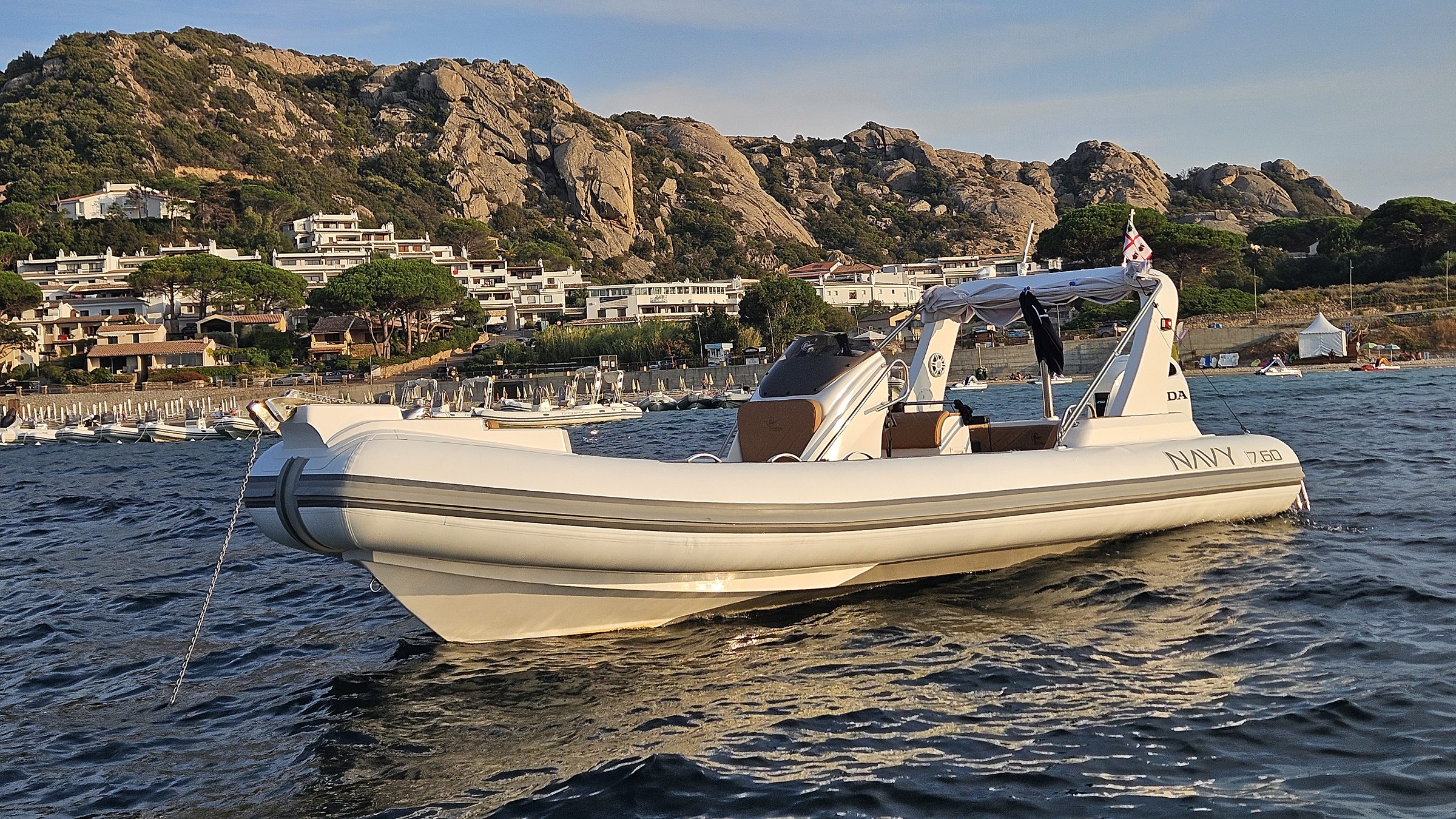
NAVY 7.60 at anchor on the right, beach with parasols and a granite mountain behind

Naviglia Yachts — how NAVY RIBs are built

How a NAVY RIB
is built

Call +39 380 173 0961Message us on WhatsApp

Fibreglass with increased thicknesses · ORCA fabric · EVA teak · one boat at a time

A RIB is judged after years of sun and salt. That is why we want to show you how a NAVY is made, layer by layer: the hull, the tubes, the decking, the upholstery, the steelwork. With the names of the materials and the real measurements, model by model.

Book your visitBook a sea trial

TAV. 02 — In three lines

Three materials,
one rule

A NAVY is made of three materials working together: fibreglass for the hull, deck, transom platforms and console, with increased thicknesses, in white or black; tubes in ORCA fabric by Pennel & Flipo, Hypalon-neoprene; and decking in synthetic EVA teak, with natural teak as an option. The rule is just one: every boat is built to order, made to measure, one at a time, with no assembly line.

The design is Italian: the moulds in which the hull takes shape are designed by Italian engineers, and every NAVY is drawn, fitted out and signed off by us, to be delivered from Aprilia (LT) to the harbour you tell us or straight to your home. On this page we open one up in front of you, from the top down, the way you would take apart a watch: first the steelwork and the roll bar, then the upholstery, the console, the bow and stern pieces, the tubes, the deck, all the way down to the hull. Then we close it up again, and tell you, material by material, what lies underneath.

The whole NAVY range

Anthracite NAVY 7.60 bow from below: deep-V hull, grey rubbing strake and stainless bow roller
FIG. 01 — Anthracite NAVY 7.60 bow from below: deep-V hull, grey rubbing strake and stainless bow roller: real photograph, showroom.

TAV. 03 — NAVY 7.60 · Naviglia vision

Take it apart
with your eyes

Naviglia vision: the NAVY 7.60 complete, seen from the stern, brown fit-out, before being opened up layer by layer
  1. Starting from the end

    NAVY 7.60 · brown fit-out

    Here it is, finished, seen from the stern. Now scroll: we open it from the top, one group of parts at a time, in the reverse order to the one in which they come on board.

  2. Off come the roll bar and the ladder

    Navigation lights · steel ladder

    The roll bar carries the navigation lights; the stern ladder is steel. They are the last to come on board and the first we take off.

  3. The steelwork

    Grab rails · handrail · bow roller

    Every grip has its place, decided on the drawing: where your hand goes when the boat rolls.

  4. The upholstery

    Sofa · sunpad · helm seat

    Three sets of cushions, cut and assembled to measure, in the colour and the line you choose.

  5. The console and the seat

    Centre console · helm unit

    The helm station lifts out in a single piece: fibreglass here too, with controls and instruments built in.

  6. Bow cap, anchor, swim platforms

    Bow and stern

    The two ends come away together. The transom platforms are built into the structure, so you can get into the water without effort.

  7. The tubes

    ORCA · Ø 52 cm · 1.3 mm

    A single ring, from stern to stern by way of the bow, in Hypalon-neoprene fabric.

  8. The deck and the decking

    Inner liner · EVA teak

    Beneath the decking lies the deck, and beneath the deck the V hull: that is what cuts through the waves.

  9. And it closes up. All at once.

    from €33,000 + VAT · engine not included

    Fifteen parts, one single boat. Below, material by material, we tell you what you have just seen.

TAV. 04

The design

First the drawing,
then the mould

A NAVY begins on a drawing table, not in the water. The lines of the hull, the height of the tubes, the position of the console and the lockers are decided on the drawing, and they become high-precision moulds designed by Italian engineers: shapes developed to cut through the water cleanly, stay stable even in a rough sea, and absorb the loads instead of passing them on to the people on board.

The mould is the part you never see, and it decides everything else. Inside the mould the fibreglass takes its final shape, layer after layer; out of the mould the hull comes with its bottom, its topsides and the housings for console and lockers already in place. So when we tell you that a NAVY is an Italian design, we are not talking about a label: we are talking about the lines on which the hull takes shape.

In the figure alongside, the NAVY 6.00 is drawn see-through: beneath the tubes and the deck you can read, in black, the structures that stay hidden once the boat is finished, namely the inner liner, the lockers, the console base and the roll-bar mountings. It is there, in what you can no longer see on the finished boat, that the way it will age over the years is decided.

Naviglia vision: the NAVY 6.00 see-through, with the structures in black beneath the tubes and the deck
FIG. 02 — Naviglia vision: the NAVY 6.00 see-through, the structures in black.
Naviglia vision: a second see-through view of the NAVY 6.00, with the structures in black

TAV. 05 — Under the skin · Naviglia vision

What you don't see
is what brings you home

Hull, deck, transom platforms and console: these are the four fibreglass parts of every NAVY. They sit one inside the other like interlocking pieces, and they hold together everything that rests on them: the engine at the stern, the people in the cockpit, the wave coming in over the bow.

TAV. 06 — Material 01 · Fibreglass

One single shell,
built in layers

Hull · deck · transom platforms · console · white or black

Fibreglass is a composite material: glass fibres and polyester or vinylester resin, laid one over the other until they become a single shell, rigid and light at the same time. Every NAVY hull is built from several layers, laid up by hand or by infusion depending on the model; the areas that work hardest, where the bottom takes the blows of the waves and where the engine pushes against the transom, are reinforced with multiaxial fabrics or reinforced cores, to gain stiffness without adding weight.

The hull takes shape in moulds designed by Italian engineers, with increased thicknesses: a choice made for durability, before weight or cost even come into it. On the outside, protecting everything, is a high-resistance marine gelcoat: it shields the hull from UV rays, the weather and abrasion, and keeps the surface glossy for years.

On a NAVY, fibreglass is used for four parts and four parts only: the rigid hull, the deck, the transom platforms and the helm console. The deck is non-slip and resistant to the sun; the platforms are built into the structure to make getting into the sea easier; the console brings controls and instruments together on a sturdy base. You choose the colour, from two: white or black.

The fibreglass hull of the NAVYs
Naviglia vision: macro of glossy white fibreglass covered in water droplets, with one large drop in the foreground
FIG. 03 — Naviglia vision: the white gelcoat, glossy beneath the droplets.
Naviglia vision: a drop of water on the white gelcoat, seen up close

Detail — 01 · The marine gelcoat · Naviglia vision

TAV. 07

Material 02 · The tube fabric

Hypalon-neoprene,
layer by layer

The tubes are the heart of a RIB, and they are the part that sun and salt put to the test first. For the NAVYs we use ORCA fabric by Pennel & Flipo, a French company with over 100 years of experience: Hypalon-neoprene (CSM/CR) with a high-tenacity polyester core; the 1.3 mm fabric on the models up to the 7.60 has a tensile strength of over 500 daN/5 cm. It is not PVC: it is technical rubber, bonded and finished by hand.

The thickness changes with the model, and we give it to you model by model. From the NAVY 4.80 to the NAVY 7.60 the fabric is 1.3 mm; on the NAVY 9.50 Cabin the tubes are in ORCA fabric by Pennel & Flipo, Hypalon-neoprene. The tube diameter, on the other hand, changes with the boat: 48 cm on the 4.80, 50 cm on the 5.50, 52 cm on the 6.00 and 52 cm on the 7.60.

  • Outside, the CSM. The outer layer of chlorosulfonated polyethylene stands up to the weather, fading, ageing, chemicals and abrasion.
  • In between, the neoprene. The intermediate layer of neoprene (CR) keeps the fabric and the rubber bonded together.
  • Inside, the seal. The inner layers of neoprene (CR) keep the tube airtight and watertight.
  • At the centre, the core. High-tenacity polyester gives the fabric its tensile strength.

A fabric like this resists UV rays without losing its colour; it stands up to knocks, scratches and rubbing against the quay, to fuels and oils, to the heat of high August and to winters in storage. And if one day it needs it, it can be repaired cold, with neoprene adhesive and hardener; ORCA fabric can still be bought by the metre years later.

ORCA fabric on the NAVYsHypalon or PVC: the guide

White tube of the NAVY 7.60 with grey NAVY 7.60 lettering and double rubbing strake
FIG. 04 — White tube of the NAVY 7.60 with grey NAVY 7.60 lettering and double rubbing strake: real photograph.

TAV. 08 — The craft · making the tubes

Cut, bonded,
put to the test

Cutting · bonding · seams · pressure test

Working the fabric is the most delicate stage of the whole build. It starts with the cutting: by hand, by specialist technicians, or with high-precision computerised systems, depending on how complex the model is. Each panel is shaped to the geometry of that particular RIB, so that the fabric works without tension and adheres evenly.

Then comes the bonding, with professional two-component adhesives chosen to withstand salt, swings in temperature and mechanical stress. Drying times, applied pressure and ambient conditions are kept under control, because a joint can only be done right once. On the most critical or most exposed joints the hand-made seams are doubled or tripled; every corner, curve and edge is finished by hand.

Finally, the test: every tube, without exception, goes through the pressure test and a visual inspection, to rule out micro-leaks, flaws or workmanship defects. Only then does the RIB move on to final assembly.

Up to 15 years' warranty
Naviglia vision: macro of the black Hypalon-neoprene fabric of a tube, with the bonded joint strip and a few drops of water
FIG. 05 — Naviglia vision: the bonded joint of a tube, seen up close.
Naviglia vision: the hand-bonded joint of a black Hypalon-neoprene tube

Detail — 02 · Where two panels become one · Naviglia vision

TAV. 09 — The choices you make, counted one by one

  • 29

    colours of ORCA fabric
    for the tubes

    Three as standard: Notte Profonda, Pietra Bianca, Blu Navy.

  • 24

    shades of EVA teak
    decking

    From T-01 to T-24, with black or grey caulking.

  • 14

    colours of the Luxury
    upholstery

    Diamond-quilted.

  • 2

    fibreglass colours
    for the hull

    White or black, inside and out.

Each figure is a choice of yours, and the choices combine with one another: that is why two NAVYs of the same size can look like two different boats. ORCA fabric also comes in more modern finishes, such as the carbon effect. You can put your combination together in the configurator and then come and see the materials in person, in the showroom in Aprilia (LT).

Naviglia vision: macro of a glossy carbon weave, black and graphite, in soft light from the left
FIG. 06 — Naviglia vision: the carbon-effect weave, one of the possible finishes.

Build your own NAVY

«Quality is built centimetre by centimetre.»
— from the NAVY series catalogue

Materials 03 · 04 · 05 · 06

What you
touch

The hull and the tubes take you to sea; the decking, the cushions and the steelwork are what you have under your feet, behind your back and in your hands all day long. They are the parts you choose last and remember first.

Naviglia Yachts logo with the compass rose engraved in the EVA teak decking
FIG. 07 — The logo engraved in the EVA teak decking: real photograph.

The standard decking

EVA teak,
no oiling

As standard, the decking on the NAVYs is synthetic EVA foam teak: ethylene-vinyl acetate that reproduces the warm look of teak but is lighter, softer under bare feet and non-slip even when wet. It needs no oiling, no sanding and no treatment: a rinse with fresh water is all it takes. It resists UV rays and salt, and it does not fade with use.

The covering is shaped to the geometry of each boat, over curved surfaces, steps, platforms and side decks, and on the 7.60 in the photograph the Naviglia logo is engraved into the decking, not glued on. Contrasting black or grey caulking lines mark out the planks. There are 24 shades in the catalogue.

Naviglia vision: macro of natural teak planks with black caulking and a few drops of water, in the low sun
FIG. 08 — Naviglia vision: natural teak, plank by plank.

The option

Natural teak,
solid wood

If you want real wood, you can ask for natural teak decking: a noble wood, with grain that runs from golden yellow to bronze, rich in an oily resin that protects it from temperature swings, mould and fungi. It is solid teak 8-12 mm thick, with a walking surface that is naturally non-slip.

Beneath the planks there are three layers: the marine adhesive, polyurethane or epoxy, which stays flexible under vibration; a waterproofing layer that seals the fibreglass against water ingress; and the preformed fibreglass panels, integrated into the rigid structure. Every plank is selected, shaped and laid by hand, following the curves of the boat.

Diamond-quilted tobacco bow sundeck beside the white tube of the NAVY 7.60
FIG. 09 — Diamond-quilted tobacco bow sundeck beside the white tube of the NAVY 7.60: real photograph.

The upholstery

Standard
or Luxury

Two lines. The Standard line, fitted as standard, is in smooth marine leatherette, treated against UV rays, salt water, mould and the weather: compact, easy to clean, still neat after a whole season. The Luxury line is in diamond-quilted technical fabric, with heat-sealed stitching that draws the diamonds and keeps the cushion in shape; it is stain-resistant, mould-resistant and sun-resistant, in 14 colours. Up to the 7.60 the Luxury line is an option.

Inside, the padding drains and does not absorb: water from the rain or from a wave does not sit in it. The stitching is reinforced and heat-sealed at the most exposed points, and every cushion is cut and assembled by hand, made to measure for the lines of that RIB.

Mirror-polished stainless bow roller of the anthracite NAVY 7.60 against the blue sky
FIG. 10 — Mirror-polished stainless bow roller of the anthracite NAVY 7.60 against the blue sky: real photograph.

The steelwork

Polished
to a mirror

Bow roller, pop-up cleats, grab rails, handrail and stern ladder: the steelwork is what you touch with wet hands, and that is why it sits exactly where your hand looks for it: at the bow for the anchor and mooring, at the console for helming, at the stern for climbing back aboard after a swim. On the bow of the anthracite NAVY 7.60, the bow roller reflects the sky like a mirror.

White NAVY 7.60 at anchor, bow three-quarter view, white houses and granite rocks behind

TAV. 12 — NAVY 7.60 · Sardinia · real photograph

All together,
in the water

Final assembly

Hull · tubes · deck · console · steelwork

Once every tube has passed the pressure test, the parts come together. This is the result, at anchor in a granite cove: the white NAVY 7.60, on an August evening.

A ring of ORCA fabric

Ø 52 cm · 1.3 mm · Hypalon-neoprene

The tube wraps around the hull from stern to stern; the double rubbing strake protects it where it meets the quay.

The console, complete with gauges

Fibreglass · helm seat · tan upholstery

On the RIBs up to the 7.60 the console comes complete with gauges, as standard. Around it, the seats in the upholstery you have chosen.

The roll bar with its lights

Navigation lights · standard up to the 7.60

The roll bar with navigation lights is standard up to the 7.60. The bimini, which you see folded away here, is an option.

The name on the tube

from €33,000 + VAT · engine not included

At the stern, on the tube, the name of the model. The engine is chosen separately: Honda, Yamaha or Mercury.

Step aboard the 7.60
Gloss black fibreglass console of the NAVY 7.60 from the side, with wheel and grab rail
FIG. 11 — Gloss black fibreglass console of the NAVY 7.60 from the side, with wheel and grab rail: real photograph, showroom.

TAV. 13

The method

Made to measure,
one at a time

Every NAVY is built to order, made to measure, one boat at a time, with no assembly line: the people who fit it out know it piece by piece, from the inner liner to the last cushion, and they know who they are building it for. That is why we are glad to take on changes. You choose the colour of the hull, white or black; the colour of the tubes; synthetic EVA teak or natural teak; Standard or Luxury upholstery.

Special requests too, such as room for diving cylinders or a relocated console, we study with our production team, on the model you have chosen. The configurator helps you put the boat together and send us the configuration; the quote arrives in writing, item by item, with the engine priced together with the boat, so you have the final figure in front of you.

  • Ready for delivery. Within 7 working days of order confirmation.
  • Made to measure, up to the 7.60. About three months from order confirmation.
  • NAVY 9.50 Cabin. We set the lead times together when the order is confirmed.
  • Payment. A deposit on confirmation, stage payments during production, the balance on delivery.

Open the configuratorDelivery and lead times

TAV. 14

Already on board

What comes
as standard

On the RIBs up to the 7.60, the console complete with gauges, the roll bar with navigation lights, the aft swim platforms, the steel stern ladder and the Standard upholstery all come as standard. The rest is up to you, and we price the options item by item on the model you have in mind: the Luxury upholstery, natural teak, tube colours beyond the three standard ones.

On the NAVY 9.50 Cabin the equipment is different, and so is the price: from €86,900 + VAT · engine not included. The interior cabin has berths and a separate bathroom. Every NAVY can be bought with or without an engine: the engine is chosen separately, by power and make, and we price it together with the boat.

  • Console complete with gauges. In fibreglass, with controls and instruments built in.
  • Roll bar with navigation lights. For staying out even once the sun has gone down.
  • Aft swim platforms. Built into the structure, covered in EVA teak.
  • Steel stern ladder. For climbing back aboard after a swim without effort.
  • Standard upholstery. Smooth marine leatherette, easy to clean.
Aft platform of the white NAVY 7.60 in teak effect with light caulking and white edge
FIG. 12 — Aft platform of the white NAVY 7.60 in teak effect with light caulking and white edge: real photograph.
NAVY 7.60 bow in the foreground with anchor chain and the sun low on the horizon
FIG. 13 — NAVY 7.60 bow in the foreground with anchor chain and the sun low on the horizon: real photograph.
Grey diamond sundeck, teak-effect deck and console seat with logo on the white NAVY 7.60

TAV. 15 — In person · real photograph

You read about the materials.
Then you touch them

In the showroom in Aprilia (LT), the materials on this page are within arm's reach: the EVA teak under your shoes, the quilting of the upholstery under your fingers, black fibreglass next to white, the tube fabric under your palm. And then there is the sea, where you really get to know a NAVY: at the first wave taken on the bow.

Book your visitBook a sea trialMessage us on WhatsApp

FIG. 14 — Grey diamond sundeck, teak-effect deck and console seat with logo on the white NAVY 7.60.

Questions about construction

Your
questions

Tubes, fibreglass, decking, lead times: here is what you ask us most often about how a NAVY is made, with the answers written out in full. Only one stays open at a time.

How is a NAVY made? What tubes does it have? How many years' warranty?

We build every NAVY to measure, one at a time, with no assembly line. From the 4.80 to the 7.60 the tubes are in ORCA fabric by Pennel & Flipo, Hypalon-neoprene 1.3 mm thick; on the NAVY 9.50 Cabin they are ORCA Hypalon-neoprene too. The hulls are fibreglass with increased thicknesses. We are so confident in our work that we offer up to 15 years' warranty.

Are the tubes on NAVY RIBs made of PVC?

No. The tubes on NAVY RIBs are in ORCA fabric by Pennel & Flipo, Hypalon-neoprene (CSM/CR) with a high-tenacity polyester core, not PVC. The fabric resists UV rays, abrasion, fuels and oils, and it is bonded with two-component adhesives. Every tube passes a pressure test and a visual inspection before final assembly on the hull.

How thick is the tube fabric on a NAVY?

It depends on the model. From the NAVY 4.80 to the NAVY 7.60 the ORCA tube fabric is 1.3 mm. On the NAVY 9.50 Cabin the tubes are in ORCA fabric by Pennel & Flipo, Hypalon-neoprene, and you will find the model's figures on its own page, or you can ask us for them.

What is the hull of a NAVY made of?

The hull of a NAVY is fibreglass: glass fibres and polyester or vinylester resin, laid up by hand or by infusion in moulds designed by Italian engineers, with increased thicknesses and reinforcement in the most heavily loaded areas. On the outside is a marine gelcoat. The deck, the transom platforms and the console are fibreglass too, in white or black.

Is the decking on a NAVY real teak?

As standard, the decking on NAVY RIBs is synthetic EVA foam teak: lighter than wood, non-slip even when wet, with no oiling or sanding, in 24 shades. If you want real wood, you can choose natural teak decking as an option: solid teak 8-12 mm thick, laid plank by plank by hand on preformed fibreglass panels.

Can the build of a NAVY be customised?

Yes: every NAVY is built to order, so we are glad to take on changes. You choose the colour of the fibreglass, white or black, the colour of the tubes from the 29 in the catalogue, EVA teak or natural teak decking, and Standard or Luxury upholstery. Special requests, such as room for diving cylinders or a relocated console, we study with our production team on the model you have chosen.

How long does it take from order to delivery of a NAVY?

For a NAVY that is ready for delivery, within 7 working days of order confirmation. For a NAVY RIB made to measure, up to the 7.60, about three months from order confirmation. For the NAVY 9.50 Cabin, we set the lead times together with you when the order is confirmed.

Bow of the NAVY 7.60 with anchor chain under a wide sunset sky

TAV. 18 — In person

You have seen it opened up.
Now take the helm

Every layer on this page you can touch in the showroom and feel under your feet at sea. Tell us what you need the boat for and what size you are thinking of: we will build the rest around you. What size do you have in mind?

Book your visitBook a sea trialAsk for a quote

Call +39 380 173 0961Message us on WhatsAppEmail us

Naviglia Yachts — Aprilia (LT), between Rome and Latina · 380 173 0961