

PLATE 01
Guide — The hull · NAVY 9.50 Cabin
The double-step hull:
why the 9.50 flies
Call +39 380 173 0961Message us on WhatsApp
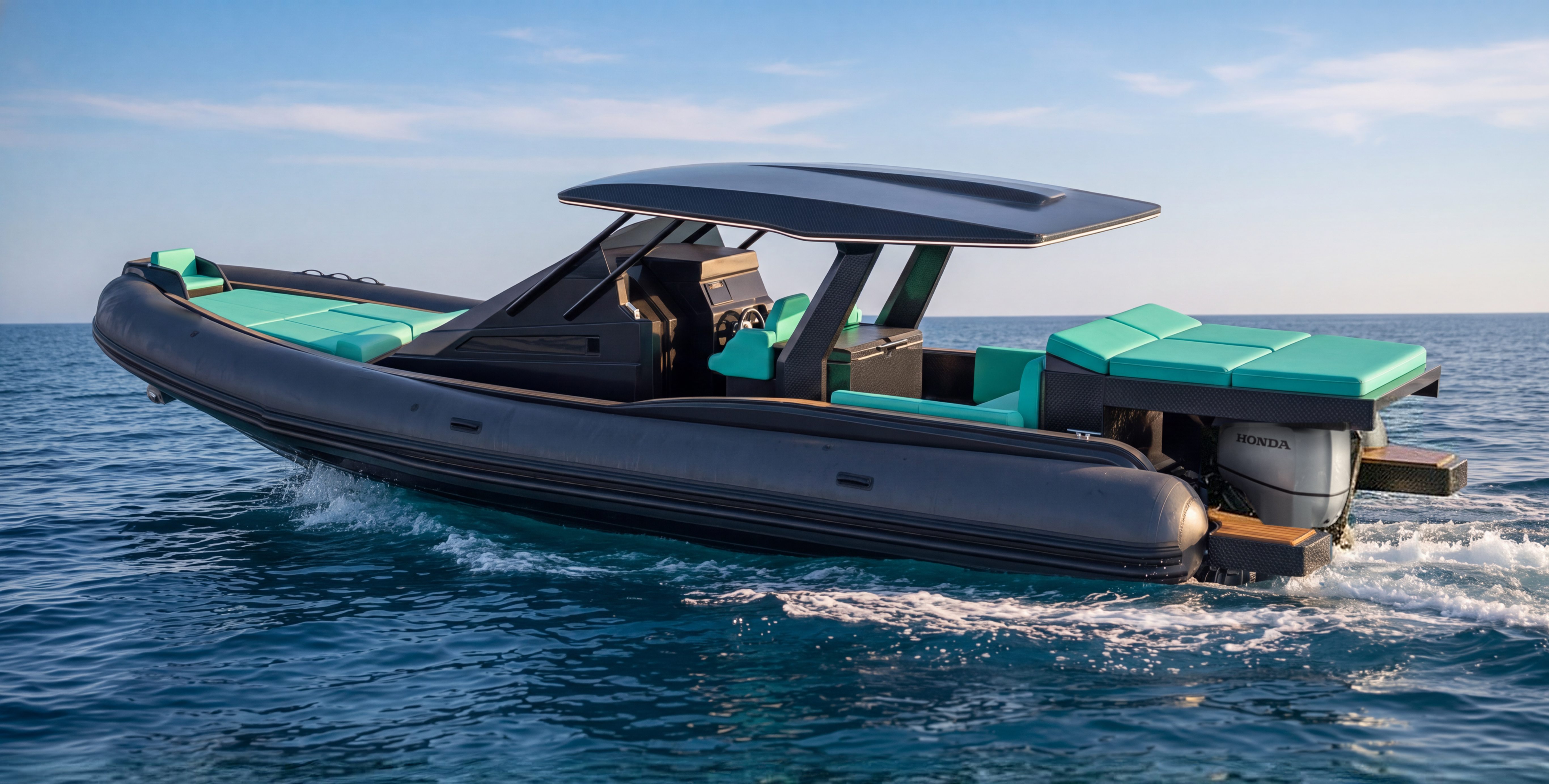
The NAVY 9.50 Cabin has a double-step hull: a V that stays deep all the way to the stern, sharp strakes either side of the keel and two transverse steps that let air in under the hull. At speed the boat rides on a cushion of air and wets less of its bottom: less friction, more speed from the same engines, less fuel at cruising speed. It is an offshore hull, the kind built to run in open water, under a cabin boat with berths and a separate heads.
Deep V · strakes · two steps · cushion of air · updated 14 October 2026
PLATE 02
What a deep-V hull is
The V,
all the way aft
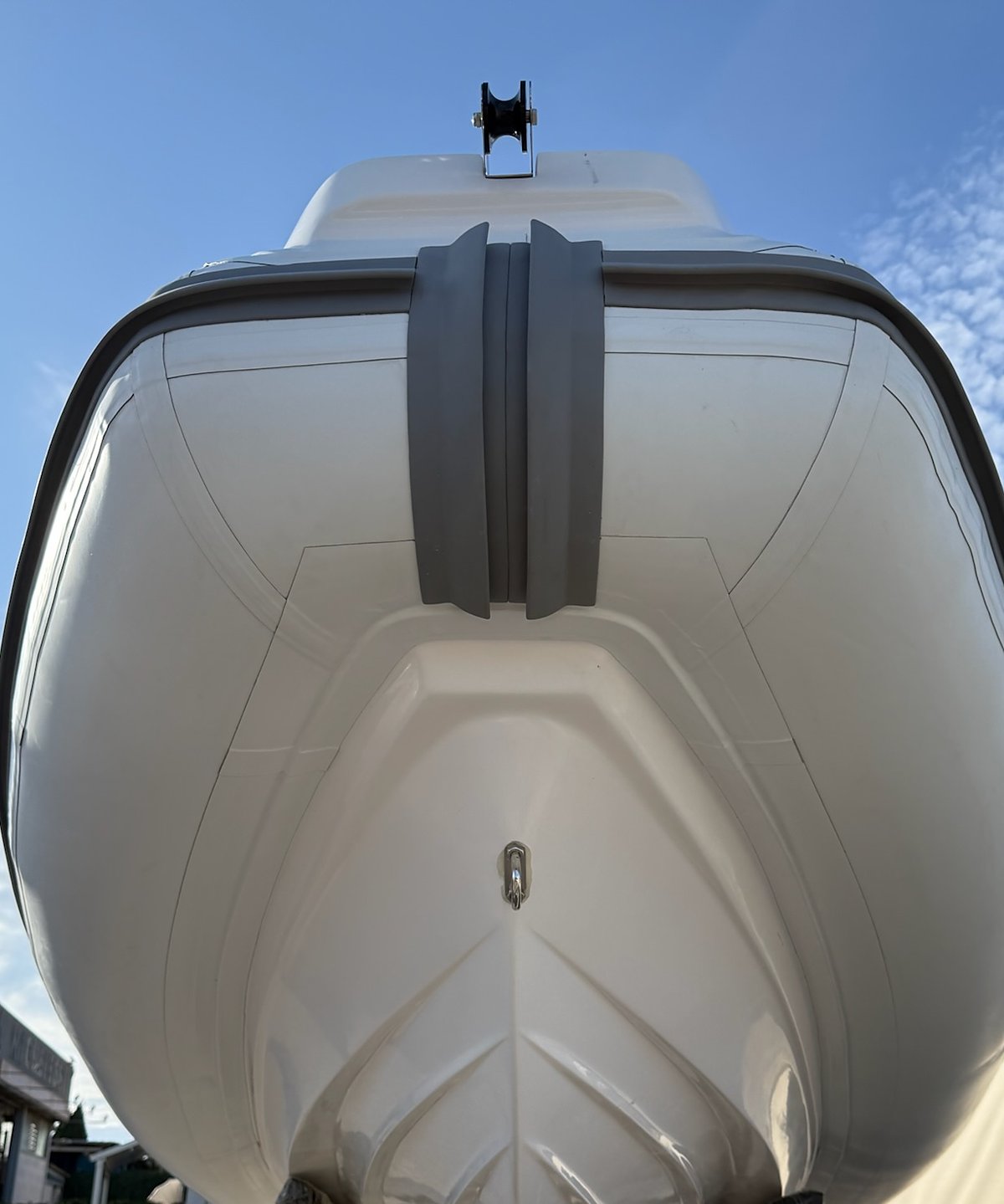
Seen from the bow, the hull of a RIB is shaped like a V: the keel in the middle, the two sides rising towards the tubes. How tight that V is decides how the boat meets a wave. A deep V enters the water like a blade and parts it; a flatter V sits on top of it, steadier at rest and harder-riding when the sea gets up. That is the trade-off in our guide to fibreglass hulls.
On many hulls the V is deep under the bow and opens out aft, to a much flatter V under the transom. Not on the 9.50: the V stays deep all the way aft. That matters: on the plane a boat runs on the after part of its hull, the part that meets the waves. If the V is deep there, the hull cuts through a rough sea instead of slamming on it, and fewer jolts reach the people on board. The price: more power, and a little more roll at rest, which the tubes along the sides keep in check.

PLATE 03
The strakes
Blades
under the hull
Along both sides of the keel run the strakes: sharp-edged fibreglass blades standing proud of the bottom, from bow towards stern. They do three jobs. Under throttle, the water striking them pushes the hull up, and the boat gets onto the plane sooner. At speed the strakes add lift and less of the hull is wet. And they turn the spray downwards, away from the people on board.
Sharp edges are not a styling detail: a crisp edge makes the water let go cleanly, so it does not cling to the bottom and the hull runs more freely. In a turn the same edges bite and hold the line, like a ski's edges on hard snow.
On the 9.50 the strakes do not run straight from end to end: they stop and start again further on, staggered, exactly where the steps are.

PLATE 04
The two steps and the cushion of air
Two steps,
a cushion of air
A step is a transverse notch in the bottom of the hull: ahead of it the bottom sits lower; just behind, it steps up, away from the water. The 9.50 has two.
On the plane, water runs along the bottom to the first step and lets go there. Behind the edge the water leaves a space, and air drawn in from the sides of the hull fills it. The same happens at the second step. The result is a cushion of air between hull and sea: a ventilated hull.
Less water on the bottom means less friction to overcome. With the same engines the boat goes faster; at the same cruising speed the engines work less and burn less fuel. The boat also stays level and composed as it runs on air. To put a number on it: a NAVY 9.50 with two Honda 350s has touched 65 knots.


IN THE ROUND — Scan of the real hull of the NAVY 9.50 · 17 September 2026
- Scan length
- 8.23m
- Scan height
- 1.39m
PLATE 05
Classic moderate V and offshore double step
Two hulls,
two jobs
Many large cruising RIBs have a classic moderate-V hull: round, full volumes, a less tight V that opens out aft, few discreet strakes. It gets onto the plane even with modest power, it is steady at rest and it forgives a newcomer at the helm: it is the hull for coastal cruising on a calm sea. It is not wrong, just made for a different use.
The 9.50's hull comes from the other family, the offshore boats: a deep V all the way aft, pronounced sharp strakes, two steps. It is built for fast passages and rough water. It asks for more power and a more attentive hand; in return, when the sea gets up, it keeps going.
| Item | Classic moderate V | Double step, NAVY 9.50 |
|---|---|---|
| The V towards the stern | opens out, the bottom flattens | stays deep |
| Strakes | few, discreet | pronounced, sharp, staggered |
| Steps | none | two, transverse |
| At rest | very steady | a little more rollthe tubes help |
| Getting on the plane | even with modest power | early, with the right power |
| In a rough sea | tends to slam | cuts through |
Two families of hulls, not two models.

PLATE 06
What changes at the helm
At the helm,
what changes
On a hull like this, five things change.

- Getting on the plane. Open the throttles and the boat is out of the water early: the strakes lift, the steps free the bottom, the boat stays level.
- Fuel. At cruising speed the engines work less, because the hull wets less of its bottom.
- Waves. In a rough sea the V that stays deep to the stern cuts through instead of slamming, above all in the short, steep chop of a windy afternoon.
- Turning. The edges of the strakes and steps bite and hold the line, and the deep V makes the boat lean into the turn. As with any fast hull, tight turns are taken after easing off the throttle.
- Power. The engines we have fitted range from two Honda 250s, for one customer, to two Honda 350s, for another. You choose the make, Honda, Yamaha or Mercury, and we decide the power together in your quote, on how you use the boat and what you carry.
Questions about the stepped hull
Double step,
in four answers
The questions we get about the 9.50's hull, with the answers we give in person. One at a time: open one and the other closes.
What is a double-step hull?
A double-step hull has two transverse steps in the bottom. On the plane the water lets go behind each one and air drawn in from the sides takes its place: the hull runs on a cushion of air, with less wetted surface and less friction. The NAVY 9.50 Cabin has a double-step hull with a V that stays deep to the stern.
Does a stepped hull use less fuel?
Yes: at cruising speed a stepped hull wets less surface and meets less friction, so the engines burn less for the same speed. How much less depends on engines, load and sea, so for the NAVY 9.50 we do not quote litres per hour: you read the real figure on the instruments on board.
How fast is the NAVY 9.50 Cabin?
The speed of the NAVY 9.50 Cabin depends on the engines, the load and the sea. What we can tell you is this: a NAVY 9.50 with two Honda 350s has touched 65 knots. With other engines the speed changes; the hull stays the same, and we decide the power together in your quote.
Is a double-step hull good in rough water?
The double-step hull of the NAVY 9.50 has a V that stays deep all the way to the stern, so in a rough sea it cuts through instead of slamming. The 9.50 is in design category B: designed for winds up to force 8 and significant wave heights up to 4 metres. In a big sea, as on any boat, speed is matched to the waves.
PLATE 08
To read after this one
The hull,
then the engine
The double step is the 9.50's case. The other questions about the hull apply to every NAVY: how a fibreglass hull is built, how much sea a design category stands, how much power each size needs.
Guide — The materials
The fibreglass hull
Rigid hull, laminate and design category: how the hull of every NAVY is built.
Read the guide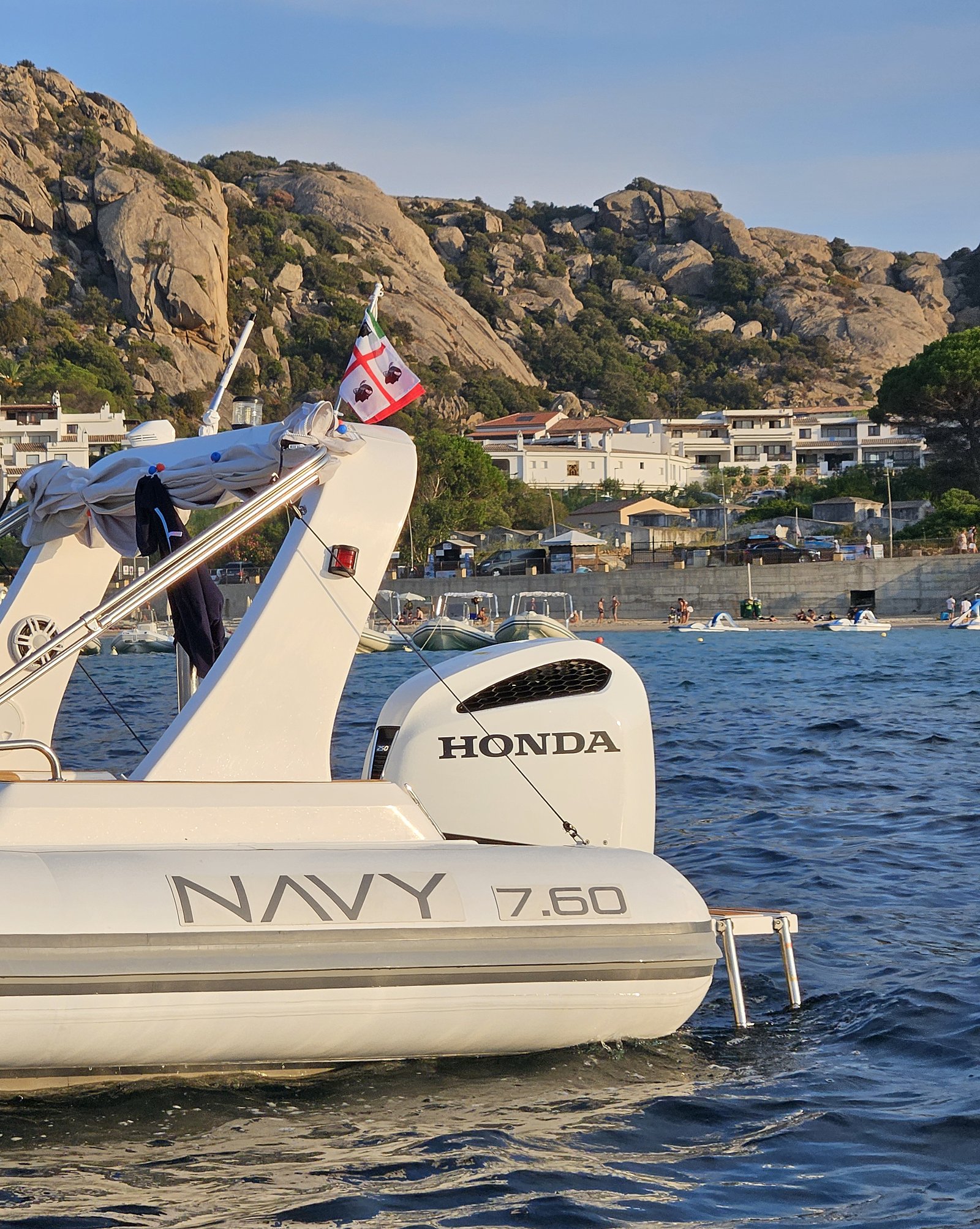
Guide — The engine
How much power
The right power for each size, from the 4.80 to the 9.50, and how we choose it together.
Read the guide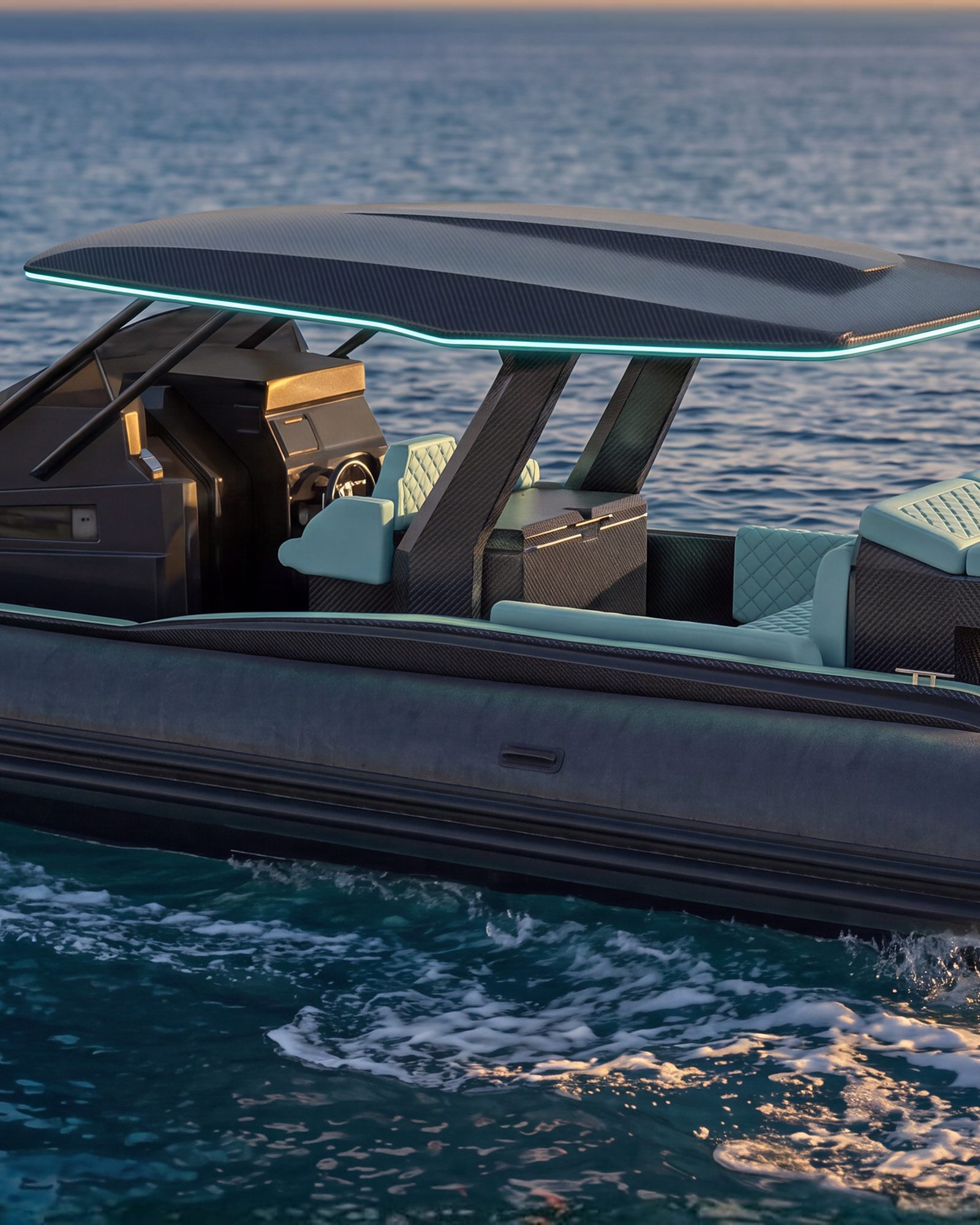
The range
NAVY 9.50 Cabin
Cabin RIB, 9.80 m overall and 3.20 m beam, design category B, up to 15 people, twin outboards.
See the model


Guide written by Naviglia Yachts, a brand of Michelessi Corporation Srl · updated 14 October 2026


PLATE 09 — In person
A hull is judged
from below
You have read how it is built; now come and see it. The 9.50 can be seen in person, by appointment: ask us to show you the hull up close, then sit at the helm. Which engines do you have in mind?
Book your visitBook a sea trialRequest a quote
Call +39 380 173 0961Message us on WhatsAppEmail us
Naviglia Yachts — Aprilia (LT), Italy · 380 173 0961