Skip to content

Italian brand

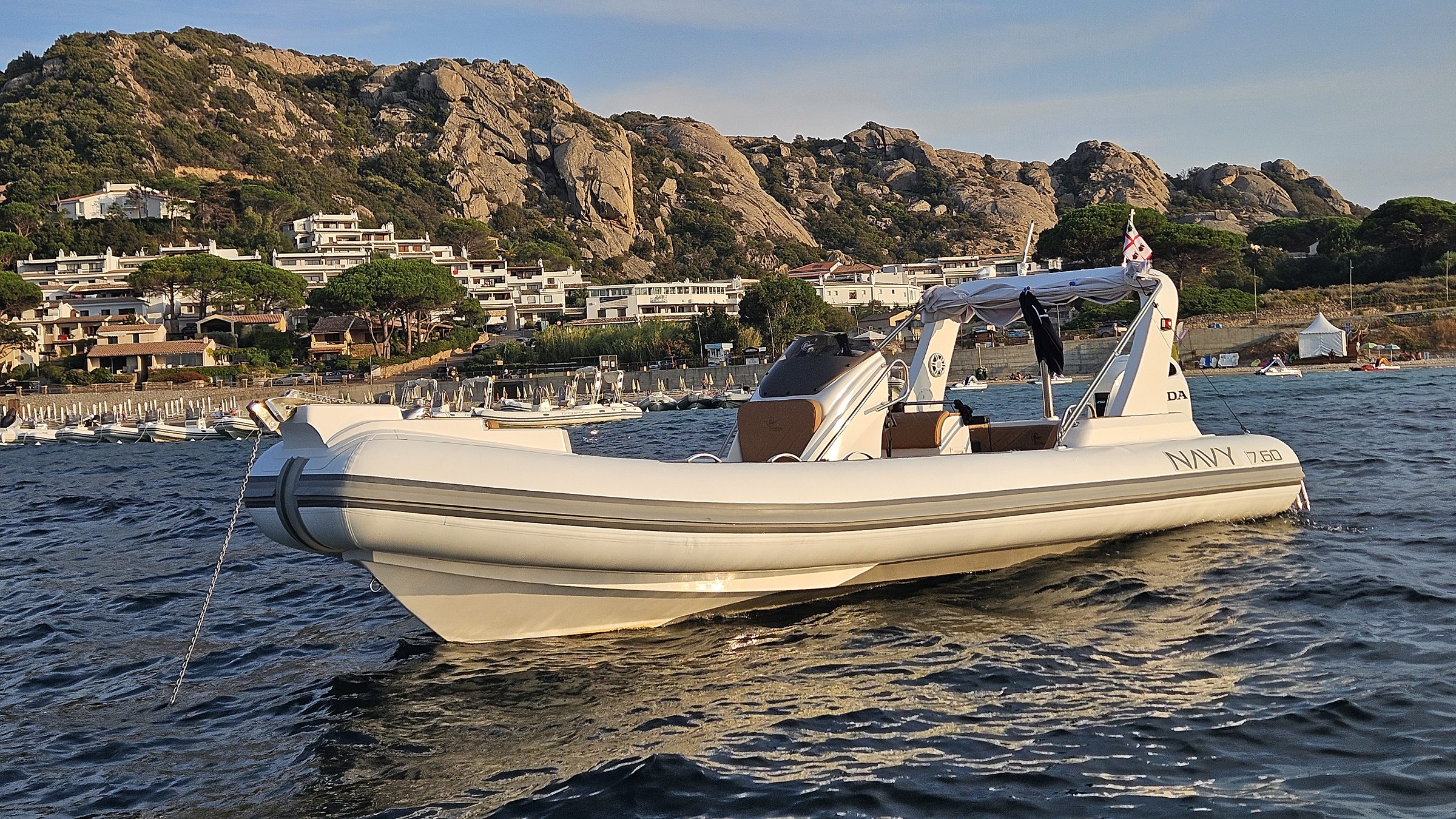
NAVY 7.60 at anchor on the right, beach with parasols and a granite mountain behind

Guide — Choosing · two types of boat compared, without taking sides

RIB or boat:
which is better?

Call +39 380 173 0961Message us on WhatsApp

Hull · tubes · rough seas · space · costs · berthing · updated 25 September 2026

A RIB like the NAVY is a boat with a fibreglass hull and inflatable tubes running all along its sides. Up to 10 metres of hull, Italian law treats a RIB and a boat alike: both are natanti, small craft, with the same rules on licence and insurance. How much sea they can take is not decided by the word ‘RIB’: it is decided by the design category on the builder’s plate. The real choice comes down to how you use the boat, the space you need and where you will keep it.

Book your visitBook a sea trial

See the NAVY range, from the 4.80 to the 9.50 Cabin

PLATE 02

The short answer

RIB or boat:
what changes

Is a RIB better than a boat? Neither type is better in absolute terms, and we say so as people who design RIBs and fit them out. A NAVY RIB has its hull, deck, stern platforms and console in fibreglass, just like a boat; on top of that, along its sides, it has tubes in ORCA Hypalon-neoprene by Pennel & Flipo. That is where the whole difference between the two types lies: in the inflatable sides, and in what they mean on board, in harbour and on the road.

For everything else, Italian law makes no distinction. Up to 10 metres of hull, measured to the UNI EN ISO 8666 standard, a RIB and a boat are both natanti, small craft (art. 3 of the Italian Recreational Boating Code). Whether you need a boat licence depends on the engine and on the distance from the coast (art. 39), and insurance is compulsory for both as soon as there is an engine on board (art. 123 of the Italian Private Insurance Code). And how much sea they can face is not set by the name of the type, but by the design category written on the builder’s plate.

A RIB and a fibreglass boat compared item by item under Italian law: what changes and what stays the same, with the rule each item comes from
ItemRIB, like the NAVYsFibreglass boat
The hullRigid fibreglass hull; on the NAVYs the deck, stern platforms and console tooFibreglass
The sidesInflatable tubes: on the NAVYs from the 4.80 to the 7.60 in ORCA Hypalon-neoprene, 1.3 mm thickRigid fibreglass topsides
In law, up to 10 m of hullNatanteart. 3, Recreational Boating CodeNatantesame rule
Registration and navigation licenceNot compulsory; registration is voluntaryart. 27, paras 1 and 2Same rule
Boat licenceAlways needed beyond 6 miles; within 6 miles it is not needed only if the engine stays within 30 kW (40.8 hp) and within the cylinder-capacity limitsart. 39, paras 1 and 3Same rule
InsuranceCompulsory with an engine, detachable ones included, of any powerart. 123, Private Insurance CodeSame rule
How much seaThe design category on the builder’s plateDirective 2013/53/EUSame rule
How far outCE-marked natante: within the limits of its category, never beyond 12 milesart. 27, para 4Same rule
How many peopleThose on the builder’s plate and in the owner’s manualart. 34, para 3Same rule
On the roadAbove 2.55 m of width an authorisation is requiredarts 61 and 10, Highway CodeSame rule
Rules of its ownReplacement of the tubes and the liferaftMinisterial Decree 146/2008, art. 57 and Annex V—

Rules read in the Gazzetta Ufficiale, the Italian official journal, and in the Official Journal of the European Union on 19 September 2026 · Recreational Boating Code = Legislative Decree 171/2005 · Private Insurance Code = Legislative Decree 209/2005 · the legal texts are in Italian.

NAVY 7.60 lying at anchor in a bay with two sailing boats and a green hillside
FIG. 01 — A wide shot of the bay: the masts of two sailing boats cut across the hillside, and the 7.60 lies lower down, on the right, with the ladder at the stern and the Honda 250 in view. Not a cloud in the sky. One RIB and two boats in the same bay: the rules for the people who skipper them are the same.
Naviglia vision: the white NAVY 7.60 under way, seen from the bow quarter, off a granite coast

PLATE 03 — What really changes · Naviglia vision

A RIB,
piece by piece

Underneath, the same fibreglass as a boat

HULL · DECK · STERN PLATFORMS · CONSOLE · IN WHITE OR BLACK

Beneath the tubes there is a rigid hull. On the NAVYs the hull, deck, stern platforms and console are in fibreglass with increased thicknesses: it is the material of a boat, not an alternative to it.

The difference: the inflatable sides

ORCA HYPALON-NEOPRENE · 1.3 MM FROM THE 4.80 TO THE 7.60 · 3 STANDARD COLOURS OUT OF 29

The tube is what turns a boat into a RIB. ORCA fabric by Pennel & Flipo has a polyester core and a tensile strength of over 500 daN per 5 cm; every tube goes through a pressure test.

The space runs from tube to tube

NAVY 7.60 · UP TO 15 PEOPLE · 7.60 BY 2.89 M

The beam of a RIB includes its tubes: on the 7.60 they are 52 cm in diameter. Inside there is a centre console complete with gauges, a helm seat with grab rail and retractable table, full upholstery and EVA synthetic teak decking.

The builder’s plate decides the sea

CATEGORIES A · B · C · D · DIRECTIVE 2013/53/EU

A RIB does not take more or less sea than a boat simply because it has tubes. What counts is the design category of the CE marking, written on the builder’s plate: always ask for it, whatever the boat.

The engine decides the licence

WITHIN 6 MILES · UP TO 30 KW, THAT IS 40.8 HP · WITHIN THE CYLINDER-CAPACITY LIMITS

In Italy the boat licence does not care whether you have a RIB or a boat: it looks at the engine and at the distance from the coast (art. 39). That is why the 40 hp outboard is the choice for those without a licence: with the 40 hp we recommend RIBs up to 6 metres.

When you need a licence

PLATE 04

The material · RIB or fibreglass boat

Fibreglass below,
fabric around

Anyone searching for ‘RIB or fibreglass boat’ often pictures two opposite materials: rubber on one side, fibreglass on the other. On a rigid-hull inflatable like the NAVY, that is not how it works. The hull is in fibreglass with a marine gelcoat, hand-laid or infused, with increased thicknesses; the deck, the stern platforms and the console are in fibreglass too, in white or black. The fabric is only where the tube is, that is, along the sides.

The NAVY tubes are in ORCA fabric by Pennel & Flipo, Hypalon-neoprene with a polyester core: 1.3 mm thick from the NAVY 4.80 to the NAVY 7.60, and ORCA Hypalon-neoprene on the NAVY 9.50 Cabin as well. The fabric is cut by hand or by machine and glued with two-part adhesives, the critical joints are hand-welded two or three times, and every tube goes through its pressure test and a visual inspection.

  • Hull and deck. Fibreglass with increased thicknesses and a marine gelcoat, in white or black: the same family of materials as a boat, beneath the tubes.
  • Tubes. ORCA Hypalon-neoprene by Pennel & Flipo. There are three standard colours, Notte Profonda, Pietra Bianca and Blu Navy, out of 29 in the catalogue.
  • Decking. Standard in EVA synthetic teak, in 24 shades, non-slip; solid natural teak from 8 to 12 mm is an option, from €3660 + VAT on the NAVY 4.80.
  • Standard up to the 7.60. Console with full instrumentation, roll bar with navigation lights, stern swim platforms, steel boarding ladder at the stern and standard upholstery.
Naviglia vision: the V hull of the NAVY 7.60 seen from astern and from below against the sky
FIG. 02 — Naviglia vision: the V hull of the NAVY 7.60 seen from below. Beneath the tubes, fibreglass.

How the hull is builtThe tube fabric

PLATE 05 — Stability and rough seas

Rough seas are read
on the builder’s plate

Design category · Directive 2013/53/EU · Italian Legislative Decree 5/2016

‘Is a RIB or a boat more stable?’ The honest answer is that the name of the type is not enough to tell you. How much sea a pleasure craft can face is set by the builder, through the design category of the CE marking, and written on the plate fixed on board, together with the maximum load and the number of people the boat has been designed for.

There are four categories. Category A is designed for winds above force 8 and a significant wave height above 4 metres; B for up to force 8 and 4 metres; C for up to force 6 and 2 metres; D for up to force 4 and 0.3 metres, with occasional waves of up to 0.5 metres. The NAVY 4.80, the NAVY 5.50, the NAVY 6.00 and the NAVY 7.60 are in category C; the NAVY 9.50 Cabin is in category B.

Then there is distance. Under Italian law a CE-marked natante sails within the limits of its category and in any case no more than 12 miles from the coast (art. 27, para 4, of the Recreational Boating Code), whether it is a RIB or a boat. The category tells you how far the boat is designed to go; how you feel on board only the sea can tell you, which is why it pays to try one before you choose.

How the hull of a NAVY works
Naviglia vision: the white NAVY 7.60 planing at sunset seen from astern, with the white wake on a golden sea
FIG. 03 — Naviglia vision: the NAVY 7.60 planing at sunset. Design category C: wind up to force 6, significant wave height up to 2 metres.
Naviglia vision: the white tube with the grey band of the NAVY 7.60 at the waterline, with the spray of the planing hull

Detail — 01 · The tube of the 7.60 at the waterline · Naviglia vision

PLATE 06 — Four figures that apply to RIB and boat alike

  • 10m

    of hull: up to there, a RIB
    and a boat are both natanti

    Art. 3 of the Italian Recreational Boating Code.

  • 12miles

    from the coast: the limit
    for a CE-marked natante

    Art. 27, para 4, of the Recreational Boating Code.

  • 2.55m

    of width: beyond it, on the road
    an authorisation is needed

    Arts 61 and 10 of the Italian Highway Code.

  • 1.3mm

    the thickness of the ORCA tubes
    from the 4.80 to the 7.60

    ORCA Hypalon-neoprene by Pennel & Flipo.

Backlit profile of the NAVY 7.60, sunburst behind the roll bar, Honda outboard astern
FIG. 04 — The sun sits behind the roll bar and fans out above the console. The 7.60 is in profile, whole from stern to bow: you can read HONDA on the cowling and 7.60 NAVY on the tube. A sail and a small island close off the horizon.
“Because the sea makes no allowances,
and neither do we.”
— Naviglia Yachts

Space on board · people, deck, cabin

Space,
measured

Space is the second question for anyone torn between a RIB and a boat. Adjectives are no help here: what you need are the number of people written on the builder’s plate, the measurements of the deck and what lies below it.

Naviglia vision: the cockpit of the anthracite NAVY 7.60 with the U-shaped sofa in quilted leather and the sea behind
FIG. 05 — Naviglia vision: the cockpit of the NAVY 7.60, for up to 15 people.

The people

How many on board,
by law

The number of people a RIB or a boat can carry is not something you judge by eye: in Italy, for a CE-marked natante, it is the number on the builder’s plate and in the owner’s manual (art. 34, para 3, of the Recreational Boating Code). On the NAVYs it ranges from 6 people on the NAVY 4.80 to 15 on the NAVY 7.60 and the same number on the NAVY 9.50 Cabin; in between, 9 on the NAVY 5.50 and 10 on the NAVY 6.00. The life-saving appliances, in turn, must be sufficient for everyone on board, crew included (art. 54, para 1, of Ministerial Decree 146/2008).

NAVY 7.60 deck seen from the bow in harbour: tan sun pad, console and teak-effect decking
FIG. 06 — NAVY 7.60 deck seen from the bow in harbour: tan sun pad, console and teak-effect decking.

The deck

From tube
to tube

On a RIB the stated beam is measured from one tube to the other, and the tubes are part of the outline: the NAVY 4.80 is 1.82 metres wide with tubes 48 cm in diameter, the NAVY 7.60 2.89 metres with tubes of 52 cm. When you compare a RIB with a boat of the same length, look at the deck plan and not only at the overall dimensions: sunpads, console, lockers and walkways change from one model to another, and they are what tells you how it feels to be on board.

Naviglia vision: the helm of the NAVY 9.50 Cabin under the hard-top, with the sliding door to the left of the dashboard drawn back into the console and the steps down to the cabin, the turquoise seats and the gloss black galley unit behind them
FIG. 07 — Naviglia vision: to the left of the dashboard of the NAVY 9.50 Cabin, the sliding door and the steps down to the cabin.

The cabin

A RIB can have
a cabin too

If you are leaning towards a fibreglass boat because you want somewhere to sleep, bear in mind that cabins are not only for boats. The NAVY 9.50 Cabin is a RIB 9.80 metres overall and 3.20 in beam, in category B, with an interior cabin with berths and a separate heads, a 500-litre fuel tank and a 150-litre fresh-water tank. List price: from €86,900 + VAT · engine not included.

How to choose a cabin RIB

Naviglia vision: the NAVY 4.80 at anchor in a granite cove on clear turquoise water, seen from above
FIG. 08 — Naviglia vision: the NAVY 4.80 at anchor, seen from above.

The smallest

Your first sea,
on a trailer

At the other end of the range is the NAVY 4.80. 4.80 m RIB with centre console, up to 6 people; with a 40 hp outboard it may be used without a licence within 6 miles of the coast (Italian limit 30 kW / 40.8 hp). It is 1.82 metres wide, so it stays below the 2.55-metre limit of the Italian Highway Code and travels on an ordinary trailer; its 5-metre trailer costs €3690 + VAT. List price: from €13,924 + VAT · engine not included.

PLATE 08

Costs, berthing, road

What it costs,
and where you keep it

On costs we give you the figures we can put our name to: our own. The NAVY range starts with the NAVY 4.80, from €13,924 + VAT · engine not included, and goes up to the NAVY 9.50 Cabin, from €86,900 + VAT · engine not included. We will not quote you the price of a fibreglass boat of the same size: we do not sell them, and a figure taken from elsewhere is not one we could stand behind.

After the purchase, many costs are the same for both types: third-party liability insurance, compulsory in Italy for every motor craft and for every detachable engine of any power (art. 123 of the Italian Private Insurance Code); the safety equipment to be carried on board ‘in relation to the navigation actually undertaken’ (art. 54 of Ministerial Decree 146/2008); fuel and engine servicing. The berth, afloat or ashore, and storage are priced by each marina on its own tariff.

Where you keep the boat is the other half of the choice. A boat that stays within 2.55 metres of width travels on an ordinary trailer and can stay at your home between outings; beyond that, on Italian roads it becomes a transport in exceptional conditions, subject to authorisation from the body that owns the road or from the Region (arts 61 and 10 of the Italian Highway Code). The rule looks at width, not at the kind of hull. For towing, mass counts too: with a category B driving licence you can tow a trailer of up to 750 kg, or a heavier one if the combination stays within 3,500 kg; for a combination of up to 4,250 kg an additional practical test is required, and beyond that you need a BE licence (art. 116).


NAVY RIBs: beam, road transport against the 2.55-metre limit, list price plus VAT with the engine not included, and trailer price
ModelBeamOn the roadList priceTrailer
NAVY 4.801.82 mordinary trailerfrom €13,924 + VAT · engine not included€3690 + VAT
NAVY 5.502.35 mordinary trailerfrom €15,900 + VAT · engine not included€4800 + VAT
NAVY 6.002.50 mordinary trailerfrom €17,987 + VAT · engine not included€4800 + VAT
NAVY 7.602.89 mexceptional transportwith authorisationfrom €33,000 + VAT · engine not included€8228 + VAT
NAVY 9.50 Cabin3.20 mexceptional transportwith authorisationfrom €86,900 + VAT · engine not included€12228 + VAT

Naviglia Yachts price list in force from 9 September 2026 · prices plus 22% VAT · the NAVY 6.60 has measurements on request (from €28,800 + VAT · engine not included) · the written quote is what counts.

Naviglia vision: the white NAVY 7.60 at anchor seen from above on turquoise water, with tan cushions and a teak-look deck
FIG. 09 — Naviglia vision: the NAVY 7.60 at anchor. At 2.89 metres wide it travels by road with an authorisation; its trailer costs €8228 + VAT.

How much a RIB costsAll the prices

PLATE 09

The rules · what Italian law says

The same rules,
except two

Italian law on recreational boating classifies craft by length and regulates them by engine, distance from the coast and use: a RIB and a fibreglass boat fall under the same rules. Only two exceptions apply to RIBs alone, and both have to do with the tubes. We set them out with the article beside them, because they are the first things anyone selling you a boat should be able to explain.

  • Replacing the tubes. For inflatable craft that hold a safety certificate, if the tubes are replaced by someone who is neither the manufacturer nor a service centre authorised by the manufacturer, the certificate has to be validated or issued afresh (art. 57, para 3-bis, of Ministerial Decree 146/2008, inserted by Ministerial Decree 133/2024). Unregistered natanti do not have a safety certificate (art. 27, para 1).
  • The liferaft. Inflatable craft, rigid-hull ones included, that are CE-marked, in category A, B or C and compliant with parts 3 and 4 of the UNI EN ISO 6185 standard are exempt from the self-inflating liferaft within 12 miles of the coast, on the conditions of Annex V of Ministerial Decree 146/2008: a survival kit and an additional fire extinguisher on board. Compliance is stated in the declaration of conformity of each individual boat: always ask for it.
  • Licence and paperwork: the same. A natante up to 10 metres of hull (art. 3), voluntary registration that brings with it the legal regime of an imbarcazione (art. 27, para 2), a boat licence according to engine and distance (art. 39): none of these rules asks whether the hull has tubes.
  • Insurance and equipment: the same. The policy is compulsory as soon as there is an engine, and it also follows a detachable engine (art. 123 of the Private Insurance Code); the safety equipment is chosen for the navigation you actually undertake (art. 54 of Ministerial Decree 146/2008).
NAVY 7.60 seen from the bow with anchor chain, beach and white houses on the hillside
FIG. 10 — The bow fills the foreground, with the grey fender and the chain running straight down into the water. Behind the boat, the beach with its parasols and the white village climbing the hillside. The sun has already dropped behind the ridge.

Guide written by Naviglia Yachts, a brand of Michelessi Corporation Srl · updated 25 September 2026 · rules read on 19 September 2026 · prices from the price list in force from 9 September 2026 · the legal texts quoted are in Italian

Questions about the choice

RIB or boat,
in eight answers

Each answer stands on its own, with its figure and its source. One at a time: open one and the other closes.

Is a RIB better than a boat?

Neither a RIB nor a fibreglass boat is better in absolute terms: it depends on how you use it, on the space you need and on where you will keep the boat. A RIB like the NAVY has a fibreglass hull and deck and, in addition, tubes along its sides. Under Italian law, up to 10 metres of hull, a RIB and a boat are both natanti, with the same rules on licence and insurance.

Is a RIB or a fibreglass boat more stable?

Whether a RIB or a fibreglass boat is more stable is not decided by the name of the type, but by the builder’s plate and a sea trial. The objective figure is the CE design category: the NAVY 4.80, NAVY 5.50, NAVY 6.00 and NAVY 7.60 are in category C, meaning wind up to force 6 and significant waves up to 2 metres; the NAVY 9.50 Cabin is in category B.

In rough seas, is a RIB or a boat better?

In rough seas what counts is the design category, not the word RIB or boat. Under Directive 2013/53/EU, category B is designed for winds up to force 8 and significant waves up to 4 metres, category C up to force 6 and 2 metres. In Italy a CE-marked natante, RIB or boat, may in any case go no further than 12 miles from the coast (art. 27, para 4, of the Recreational Boating Code).

Does a RIB need the same licence as a boat?

In Italy a RIB follows the same licence rules as a boat, because they depend on the engine and the distance, not on the hull. Within 6 miles of the coast no licence is needed if the engine does not exceed 30 kW, that is 40.8 hp, or the cylinder-capacity limits of art. 39 of the Recreational Boating Code; beyond 6 miles it is always required. With a 40 hp engine we recommend RIBs up to 6 metres.

Is a RIB registered like a boat?

Under Italian law a RIB with up to 10 metres of hull is a natante, exactly like a fibreglass boat of the same size: it is exempt from registration in the central electronic register, from the navigation licence and from the safety certificate (art. 27, para 1, of the Recreational Boating Code). It can be registered by choice, and then takes on the legal regime of an imbarcazione, a registered pleasure craft (art. 27, para 2).

Does keeping a RIB cost less than keeping a boat?

After the purchase, a RIB and a boat have the same running costs: compulsory insurance with the engine, fuel, servicing, the berth and storage, which each marina prices on its own tariff. The practical difference is the beam: the NAVY 4.80, the NAVY 5.50 and the NAVY 6.00 stay within the 2.55 metres of the Italian Highway Code and can be kept at home, on their trailer.

Can a RIB have a cabin like a boat?

Yes, a RIB can have a cabin too. The NAVY 9.50 Cabin is a RIB 9.80 metres overall and 3.20 in beam, in category B and for up to 15 people, with an interior cabin with berths, a separate heads and twin outboards at the stern. List price: from €86,900 + VAT · engine not included.

What are NAVY RIBs made of?

NAVY RIBs have their hull, deck, stern platforms and console in fibreglass with increased thicknesses, in white or black, and tubes in ORCA Hypalon-neoprene by Pennel & Flipo: 1.3 mm from the 4.80 to the 7.60, and ORCA on the 9.50 Cabin as well. Every tube goes through a pressure test and a visual inspection, and we build every boat to order, one at a time, with no assembly line.

NAVY 7.60 at sunset seen from astern, lettering on the tube under a wide blue sky

PLATE 12 — In person

The real comparison
happens at sea

The tables tell you what changes between a RIB and a boat; a sea trial tells you which one suits you. Step aboard a NAVY, feel how it moves and what it is like to be on board, then we will choose the size and the engine together, with every item written in the quote. What use do you have in mind?

Book your visitBook a sea trialRequest a quote

Call +39 380 173 0961Message us on WhatsAppEmail us

Naviglia Yachts — Aprilia (LT), Italy · 380 173 0961