Skip to content

Italian brand

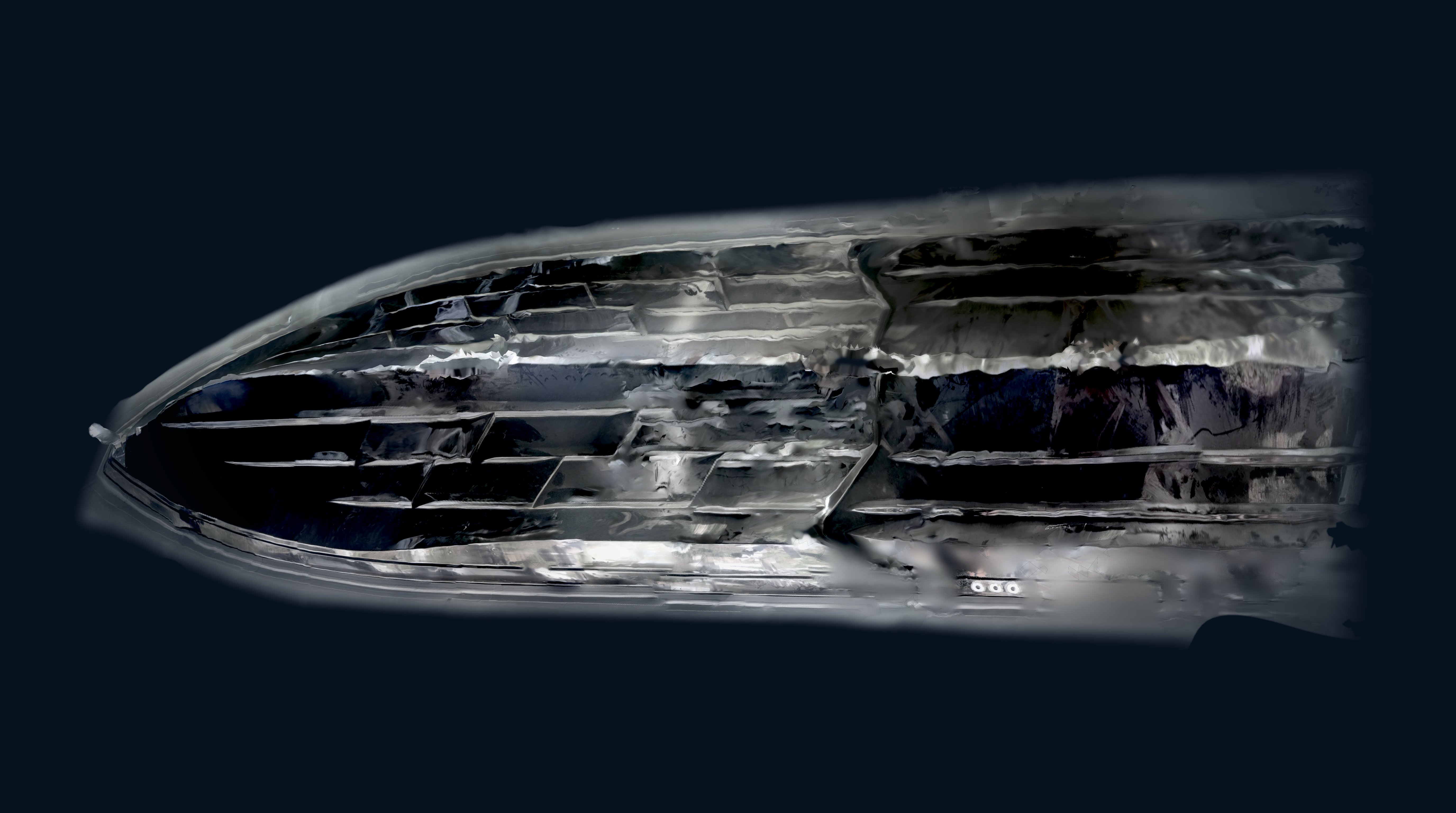
Three-dimensional scan of the real hull of the NAVY 9.50, whole, seen from below, from the tip of the bow to the stern: the keel in the centre, the bands of the strakes and the steps where the strakes break off and start again, staggered

NAVY 9.50 Cabin · the hull · the scan of the real hull

Beneath the NAVY 9.50:
an offshore hull

Call +39 380 173 0961Message us on WhatsApp

A V deep to the stern · sharp strakes · two steps · a cushion of air

A V that stays deep all the way to the stern, sharp strakes, two steps and a cushion of air. The hull of the NAVY 9.50 Cabin told from underneath, the way you tell the story of a boat born to run in open water.

Come and see it from belowBook a sea trial

Back to the NAVY 9.50 Cabin page

PLATE 02 — The opening · the real hull

You understand a boat
from below

There is a moment when you truly understand a boat, and it is not on the water. It is when the boat sits high on its stands, with grass beneath it and the sky reflected in the black bottom, and you walk round it with your head tilted back. From above, the NAVY 9.50 Cabin is a hard-top, a sofa, a cabin; the part that decides how you take a wave is on the other side, where usually only the water goes. Seen from below it is something else: a blade 9.80 metres overall, with the bands of the strakes running towards the bow and breaking off, and a V that does not give up even at the stern.

Offshore boats, the ones born to run in open water, have hulls like this: drawn for a race that starts again with every wave, the boat against the sea. We wanted the 9.50's hull to come from that family, an offshore hull, and this page explains piece by piece what that means for the people on board: in the back, in the stomach, in the hands on the wheel.

To tell its story we photographed and filmed it from underneath, on its stands. Then there is the three-dimensional scan of the real hull. Here you will find the photographs of the real hull, the Naviglia visions drawn from those photographs, and the scan, to turn with one finger.

The double-step hull, explained

Naviglia vision from a photograph of the real hull: the gloss black bottom of the NAVY 9.50, a deep-V, double-step hull, seen up close from below, with sharp strakes that stop and start again, staggered
FIG. 01 — Naviglia vision, from a photograph of the real hull: the gloss black bottom of the NAVY 9.50 seen from below and up close, polished to a mirror. The bands of the strakes run along the hull, stop and start again further on, staggered, with wedge-shaped faces and hard edges. That is where the bottom steps.
Naviglia vision from the three-dimensional survey of the real hull: the gloss black hull of the NAVY 9.50 seen from below the waterline turning from the bow to the side, with sharp strakes broken by the two steps

PLATE 03 — The real hull, from the three-dimensional survey · Naviglia vision

Where the water
does its work

01This is the real hull, from the three-dimensional survey: the V stays deep all the way to the stern.

02The strakes break at the steps, and start again further on, staggered.

03Behind every step the air comes in: the hull runs on a cushion of air.

PLATE 04

Chapter 01 · Born for open water

Born for
open water

Offshore, where the sea has had time to build, the water is not a backdrop: it is the opponent. A hull born to run there has to do two things that seem to pull against each other: cleave the sea when it meets it, so that the wave does not become a blow, and touch as little of it as possible when it is running, because every hand's breadth of wetted bottom is drag, and drag is paid for in fuel. It is the same idea as the offshore racers, where every litre and every horsepower must push the boat, not the water.

The hull of the NAVY 9.50 Cabin solves the problem the way they do: a bow that opens the wave, a bottom that lifts at speed and breaks free of the water. It is a hull designed to fly over the water rather than push it. And it is, within reason, an extreme hull: it asks for power and for a more attentive hand. In return it gives seakeeping, stability in the turn and speed, all three together.

The design is Italian, the NAVY hulls come from moulds designed by Italian engineers, and the hull in these photographs is that very one: an offshore bottom under a boat made for living.

Naviglia vision from a photograph of the real hull: the gloss black hull of the NAVY 9.50 seen from the side, from the bow, in a dark studio, lightened to read the sharp strakes that stop and start again, staggered
FIG. 02 — Naviglia vision, from a photograph of the real hull: the 9.50 side-on and slightly from below, bow to the left. The sharp strakes run along the hull, stop and start again, staggered, with hard edges.

The hull in one letter

V

deep all the way to the stern, where the boat runs on the plane

PLATE 05

Chapter 02 · The back

The back: a V that stays
deep to the stern

Let us start with the blow that never lands. In the short chop of a windy afternoon, on many boats every wave is a sharp slam that travels up from the seats into the spine; after an hour you come home with a back begging for mercy. A flat hull meets the wave like a palm slapping the water. A deep-V hull goes in like the edge of the hand: the water opens, the cut is clean and progressive, and fewer jolts reach the people on board in a rough sea, with more comfort at sustained speeds.

Seen from the bow, the hull of the 9.50 is a tight, pronounced V: the keel in the middle like the edge of a blade, the sides rising steeply towards the tubes. On many hulls the V is deep under the bow and then opens out towards the transom, the wall at the stern where the engines hang. Not on the 9.50: the V stays deep all the way to the stern. That is exactly where it counts, because on the plane the bow is out of the water and the boat runs on the after part of its hull. If the V is deep there, the hand stays edge-on even when you are running fast.

What you get is a boat that stays composed on its axis, one that holds its line in tight turns and at high speed: control, not magic. The price: a deep V asks for more power to get onto the plane and, at rest, rolls a little more. The tubes along the sides, ORCA fabric by Pennel & Flipo in Hypalon-neoprene, keep that roll in check; anyone who has spent an hour in short chop pays it gladly.

Three-dimensional scan of the real hull of the NAVY 9.50, seen from the bow and from below: the slender keel, the V opening out towards the sides, the strakes converging towards the tip of the bow
FIG. 03 — Three-dimensional scan of the real hull · 17 September 2026, seen from the bow and from below: the slender keel, the V opening out towards the sides, the strakes converging towards the tip of the bow.

PLATE 06

Chapter 03 · The stomach

The stomach: the strakes,
the blades under the hull

The second sensation comes when you open the throttles. On some boats the bow rises, the engine screams, and for a time that feels long you stare at the sky waiting for the hull to make up its mind and climb; your stomach, meanwhile, stays behind. On the 9.50 that wait is short, and the credit goes to the blades running under the hull on either side of the keel: the strakes. Long blades standing proud of the bottom from bow towards stern, sharp, pronounced, hard-edged; on the black hull they look like lines of silver. They do three jobs.

The first is to lift: the water striking the strakes pushes the hull upwards, immediate lift, and the boat gets onto the plane early, in a moment. The second is to lighten: at speed the hull rides on the strakes more than on its bottom, wets less surface, runs freer on the same engines. The third you feel on your face: the spray climbing the sides is turned downwards, away from the people on board; with the wind on the beam, the difference between a dry afternoon and a drenched one lies entirely there.

Now look at them, in the photographs of the real hull. The strakes do not run straight from one end to the other: at a certain point they stop and start again further on, staggered, and the band nearest the keel does not stop at the same point as the outer one. Each break has a clean, wedge-shaped face. It is not a quirk of the mould: that is where the bottom steps, and in the flesh a step shows itself like this, where the strakes break, not as a line drawn across the bottom.

Naviglia vision from a photograph of the real hull, from below looking up, with the grass and the trees reflected in the black: two bands of strakes that stop and start again, staggered, with wedge-shaped faces; at the bottom, the keel
FIG. 04 — Naviglia vision, from a photograph of the real hull, from below looking up, with the grass reflected in the black: two bands of strakes that stop and start again, staggered, with wedge-shaped faces; at the bottom, the keel. At speed the boat rides on these blades more than on its bottom.

The hull in one number

2

steps: two transverse notches in the bottom of the hull

PLATE 07

Chapter 04 · The two steps

The two steps
and the cushion of air

That choice has a name: a step. A step is a transverse notch in the bottom of the hull: ahead of the step the bottom sits lower; just behind, it pulls up sharply. On the 9.50 there are two of them: a double-step hull.

Follow the water. On the plane it runs along the bottom, clinging to it, as far as the first step. There the hull draws back abruptly and the water, which travels straight, has no time to follow: it lets go. Behind the edge there is a space the sea does not close again at once, and air drawn in from the sides of the hull comes to fill it. The same happens at the second step. The result is a cushion of air between hull and sea, and that is why the hull is said to be ventilated: it runs on a mattress of air, and on air the trim stays level and steady.

Far less water on the bottom means far less friction. With the same engines the boat goes faster; at the same cruising speed the engines work less hard and burn less fuel. How much depends on engines, load and sea: that is why we do not give you a number, we give you the shape. The step is the point where this hull stops pushing the water and starts flying over it.

Naviglia vision: close-up of the steps of a double-step hull in white gelcoat, with wedge-shaped faces and sharp strakes that stop and start again, staggered
FIG. 05 — Naviglia vision: the steps up close, on a hull in white gelcoat. On white, without the reflections of the black, the wedge-shaped faces and the strakes starting again, staggered, are easier to read.

PLATE 08 — Chapter 05 · The wheel

The wheel:
hard edges

Edges that make the water let go · deflectors · symmetrical running surfaces

The third sensation is in your hands. In a turn you feel the boat lean in and hold its line, like the edges of a ski on hard snow. On the 9.50 that grip comes from the edges: the side volumes of the hull have hard, pronounced edges, the strakes, the faces of the steps, the chines between one running surface and the next. They are edges that make the water let go, and they also act as deflectors, that is, they send the water where it is needed.

Think of the edge of a roof in the rain. A rounded edge lets the water trickle down the wall; a sharp edge makes it break away at once. Under the hull the same thing happens: the edge breaks the tension that keeps the film of water stuck to the bottom, the water lets go, the hull runs free. The same edges turn the spray downwards and give directional stability: in a turn they bite the water and hold the line.

Then there is a precision you feel from the engines. The design is worked with care around the steps and along the lower surfaces so that clean water reaches the gearcases of the engines: the propellers must work in solid water, not in a wake of bubbles. It is a purpose of the design. The lines of the volumes, like the running surfaces, are symmetrical: the two halves of the hull mirror one another.

The NAVY 9.50 Cabin page
Naviglia vision: the NAVY 9.50 with turquoise upholstery, three-quarters from the stern, under way at dusk, with the two silver Honda outboards under the sunpad and the line of light on the hard-top
FIG. 06 — Naviglia vision: the NAVY 9.50 under way at dusk, three-quarters from the stern, with the turquoise upholstery and the two silver Honda outboards under the sunpad.

Chapter 06 · The real hull

Polished to a mirror:
the real hull

The boat in these photographs is a 9.50 we have fitted out for a customer. The hull is gloss black, polished to a mirror: you can read the grass and the sky in it. The 9.50's hull comes in white or black; the grey tubes with the two-stripe anthracite rubbing strake, the black hard-top and the NAVY lettering on the tube belong to this boat, and the colour of the tubes is yours to choose. On the engine cowlings you read 250: they are the two Honda 250s fitted for this customer.

  • Blackgloss, polished to a mirror: you can read the grass and the sky in it
  • 250the two Hondas fitted for this customer
  • 8.23 mscan length, cut short at the stern
  • 1.39 mscan height: the measurements of the survey, not of the boat

Gloss black forgives nothing

Gloss black has a merit beyond beauty: it forgives nothing. A hesitant step face or a blade with a crooked edge would show at once. There are none here. A finish like this comes from the moulds, designed by Italian engineers, and from a care for detail that nobody usually goes looking for under a boat. The fibreglass has increased laminate thickness.

The photographs and the films show the walk round on the stands, the black hull from below with the strakes and the step faces, the details up close, including on a hull in white gelcoat, where the wedge-shaped faces can be read without the reflections of the black; the Naviglia visions are drawn from those photographs. Then there is the three-dimensional scan of the real hull, from 17 September 2026: with no sea, no stands and no deck, only the shape is left, from below, for almost the whole length. Scan length 8.23 metres, scan height 1.39 metres: these are the measurements of the survey, cut short at the stern, not those of the boat. In the viewer you turn it as if you were walking underneath.

Naviglia vision, from a photograph of the real hull: the NAVY 9.50 on its stands at sunset, seen from the stern and from below, with the two Honda 250s, the NAVY 9.50 lettering on the grey tube and the gloss black hull with the bands of the strakes that stop and start again, staggered, and a clean bow
FIG. 07 — Naviglia vision, from a photograph of the real hull: the 9.50 on its stands at sunset, seen from the stern and from below, with the two Honda 250s and the NAVY 9.50 lettering on the grey tube. In the gloss black the bands of the strakes stop and start again, staggered; towards the bow they taper and end, and the V reaches the tip clean.
Three-dimensional scan of the real hull of the NAVY 9.50, seen from below, bow to the right: the keel in the middle, the bands of the strakes and the two steps where the strakes break
FIG. 08 — Three-dimensional scan of the real hull · 17 September 2026, seen from below, bow to the right: the hull from the bow to just short of the transom, the keel in the middle, the bands of the strakes and the two steps where the strakes break. Scan length 8.23 m.

The scan of the real hull

A hull
to turn

SCAN OF THE HULL · TO TURN · FROM BELOW · FROM THE SIDE

What follows is not a photograph: it is the three-dimensional scan of the real hull, taken on the hull itself. Without the sea, the stands or the deck, only the shape is left: the V, the strakes running towards the bow, the steps where the strakes break. Press “Explore the scanned hull” and turn it as if you were walking underneath.

Three-dimensional scan of the real hull of the NAVY 9.50 seen three-quarters from below and astern: the black V bottom, the strakes running towards the bow and the steps where they break off

IN THE ROUND — Scan of the real hull of the NAVY 9.50 · 17 September 2026

Scan length
8.23m
Scan height
1.39m

PLATE 10

Chapter 07 · Two hulls, two jobs

Against a classic
moderate-V hull

To understand a shape you have to set it beside another. We did it with a large and very well-known RIB with a classic moderate-V hull, and at the end we told ourselves we had done an excellent job. But the comparison is there to understand more than to win: the two hulls do two different jobs.

The classic moderate-V hull has round, full volumes, a less tight V that opens out towards the stern, few discreet strakes. It favours comfort and stability at rest, gets onto the plane even with little power, is simple to handle: the hull of coastal cruising, of the family, of calm seas. It is not wrong: it is made for another use, and it does it well. Anyone who always comes home on a flat sea is right to choose it.

The 9.50's hull plays in a different league. It is sporting, sharp, technical, devoted to performance, to fast passages, to the decisive cut through a built-up sea, with the seakeeping of an offshore RIB. It asks for more power and more attention at the helm; in return, when the sea gets up and the others slow down, this one keeps going, and the built-up sea becomes a road instead of a wall.

Two families of hulls, two jobs: the moderate V for the coast on a calm sea, the offshore double-step hull for fast passages and rough water. Choosing the 9.50 means choosing the second, and knowing it.

Classic moderate-V hull and offshore double-step hull, line by line
ItemClassic moderate VDouble step, NAVY 9.50
The V towards the sternopens out, the bottom flattensstays deep
Strakesfew, discreetpronounced, sharp, staggered
Stepsnonetwo, transverse
At restvery steadya little more rollthe tubes help
Getting on the planeeven with modest powerearly, with the right power
In a rough seatends to slamcuts through

Two families of hulls, not two models.

Three-dimensional scan of the real hull of the NAVY 9.50, seen from the side, bow to the right: the line of the hull rising towards the bow, the parallel strakes and the steps where the strakes break
FIG. 09 — Three-dimensional scan of the real hull · 17 September 2026, from the side, bow to the right: the line of the hull rising towards the bow, the parallel strakes and the steps where the strakes break.

The hull in one number, from another 9.50

65

knots, touched by a 9.50 with two Honda 350s

PLATE 11

Chapter 08 · There are two boats

A number,
from another 9.50

To give the measure of what V, strakes and steps do together, one number is enough: a NAVY 9.50 with two Honda 350s has touched 65 knots. It is not a target to repeat every Sunday: it says how much work there is under the hull.

Here we need to be clear, because there are two boats. The boat behind the number is a 9.50 fitted out for a customer, with two Honda 350s. The boat in the photographs and films on this page is another 9.50, fitted out for another customer, and it carries two Honda 250s: you read it on the cowlings. The pictures are of this one, with the 250s; the number belongs to the other. We never put them together.

That number, on a cabin boat 9.80 metres overall, says that the cushion of air does its job and that the hull, at that speed, touches little water. With different engines the speed changes; the double-step hull stays the same. Even with two Honda 250s the boat gets onto the plane promptly and cruises efficiently: the living space of a cabin boat of almost 10 metres with the bite of an offshore boat.

The engines we have fitted so far range from two Honda 250s, for one customer, to two Honda 350s, for another. You choose the make from Honda, Yamaha and Mercury, and we decide the power together with the quote. That number is the measure of the hull, not a promise about every day at sea.

PLATE 12

Chapter 09 · The run home

The run home: what
changes on board

Put the three sensations together and picture the run home. You went out on a flat sea, you swam, you had lunch in the cockpit, and in the afternoon the wind turned and the sea got up. The run home is the moment a hull reveals itself.

In a rough sea the V, deep all the way to the stern, cleaves the wave instead of slamming on it: your back does not count the blows, your stomach does not stay behind. The strakes keep the boat lifted and dry, the edges hold the course. The steps work in silence: less water underneath, level trim, engines that do not labour. It is the speed of a ventilated hull with the comfort of a much larger boat, designed for the open sea.

Above it there is no racing cockpit: there is a cabin boat. An interior cabin with berths and a separate heads, an outdoor galley behind the helm, a hard-top of 2.50 by 3.70 metres, up to 15 people, 500 litres of fuel and 150 of water, on 9.80 metres overall and 3.20 of beam. Design category B: designed for wind up to force 8 and a significant wave height up to 4 metres.

Three rules at the helm, valid for every fast hull. A V hull leans into the turn, like a motorcycle: that is normal. Tight turns are taken after easing off the throttle, not under full power. And in a big sea the speed is matched to the waves: the steps and the strakes raise the bar, they do not remove it. Category B is a design limit, not an invitation. An offshore hull under a home on the water: that is the 9.50.

Naviglia vision: the helm of the NAVY 9.50 Cabin under the hard-top, with the wheel on the right, the two screens, the turquoise helm seats and, to the left of the dashboard, the sliding cabin door drawn back into the console
FIG. 10 — Naviglia vision: the helm of the 9.50, under the hard-top, with the wheel on the right and the sliding cabin door on the left. This is where you feel the hull.

Back to the 9.50The double-step hull, explained

The photographs of the real hull

Sixteen frames
of the real hull

They are frames from the films shot under the boat, on its stands: no retouching, the hull as it is; the last three show a hull in white gelcoat, where the step faces can be read without the reflections of the black. Tap a picture to open it full screen and move through them with the arrows or your finger; under each card, “The story” tells you what you are looking at. From bow to stern: the V, the strakes, the wedge-shaped faces of the steps, the keel.

The whole boat, from the bow

FIG. 11 — Photograph of the real hull: the whole 9.50 on its stands, seen from the bow and from below.

The whole NAVY 9.50 Cabin on its stands, seen from the bow and from below: the black V of the hull, the anchor at the bow roller, the grey tube and the hard-top, the stern at the far end.

It is the only frame in which the whole hull can be seen, from bow to stern: the walk round starts here and goes down under the boat.

High on its stands, from the bow

FIG. 12 — Photograph of the real hull: the 9.50 out of the water, seen side-on from the bow.

The NAVY 9.50 Cabin out of the water, high on its stands, seen side-on from the bow: the grey tube with the anthracite rubbing strake, the black V of the hull, the anchor hanging from the bow roller.

This is where the walk round begins: head tilted back, grass below and black fibreglass above. From here on the photographs go under the boat.

The bow head-on, from below

FIG. 13 — Photograph of the real hull: the black V closes on the keel like the edge of a blade.

The bow head-on, from below. The black V closes on the keel like the edge of a blade; above, the tube and the bow roller with the anchor.

This is the view that explains the back: a V this tight goes into the wave like the edge of the hand, and the cut is clean and progressive.

The bow from below: the V and the first strake

FIG. 14 — Photograph of the real hull: the glossy black V dropping to the keel and the first strake running aft.

The bow seen from below, foreshortened: the glossy black V dropping to the keel, the chine and the first strake running aft, with the lawn reflected in the black.

It is the bow this whole page talks about: a V this closed cuts into the wave edge-on, and the strake starts working the moment the water touches it.

Where the strakes end, towards the bow

FIG. 15 — Photograph of the real hull: towards the bow the strakes taper and the keel rises.

Towards the bow the strakes of the NAVY 9.50 taper and end, and the keel rises towards the bow roller.

This is the part of the hull that opens the wave: here the V is at its tightest and the bottom, on the plane, stays out of the water.

From below, towards the bow

FIG. 16 — Photograph of the real hull: the black bottom from the stands towards the bow, with the strakes running forward.

The black bottom of the NAVY 9.50 seen from below, from the stands towards the bow, with the strakes running forward and the grass at the sides.

On the black hull the strakes look like lines of silver: long blades standing proud of the bottom, with hard edges.

Two bands of strakes, from below

FIG. 17 — Photograph of the real hull, looking up from below: two bands of strakes with their staggered step faces.

From below looking up, with the grass reflected in the black: two bands of strakes that stop and start again, staggered, with wedge-shaped faces; at the bottom left, the stands.

At speed the boat rides on these blades more than on its bottom: it wets less surface and runs freer on the same engines.

The side, amidships

FIG. 18 — Photograph of the real hull: the side amidships, the strakes stopping and starting again, staggered.

The side, amidships. The strakes stop and start again further on, staggered, and each break has its own wedge-shaped face; the grass is reflected in the black.

The band nearest the keel does not stop at the same point as the outer one: in the flesh a step shows itself like this, where the strakes break.

The staggered strakes

FIG. 19 — Photograph of the real hull: the strakes stopping and starting again, staggered, seen from below.

The strakes of the NAVY 9.50 stopping and starting again, staggered, seen from below, with a stand and the grass behind.

It is not a quirk of the mould: that is where the bottom steps, and behind every step, at speed, the air drawn in from the sides comes in.

The blades, up close

FIG. 20 — Photograph of the real hull: the strakes up close, sharp, with the wedge-shaped faces where they break.

The strakes up close, sharp, with the wedge-shaped faces where they break, in the gloss black of the NAVY 9.50 hull.

They are edges that make the water let go: they break the tension that keeps the film of water stuck to the bottom, turn the spray downwards and bite the water in a turn.

The wedge-shaped faces, head-on

FIG. 21 — Photograph of the real hull: the wedge-shaped faces of the strakes seen head-on, where the bottom changes level.

The wedge-shaped faces of the strakes seen head-on, where the bottom of the NAVY 9.50 changes level.

Ahead of the step the bottom sits lower; just behind, it pulls up sharply: this is where the water lets go and the cushion of air begins.

The step faces

FIG. 22 — Photograph of the real hull: the step faces up close, where the strake ends in a clean wedge.

The step faces up close. Where the strake ends, the bottom changes level with a clean wedge; the strake starts again further on, staggered.

Behind each of these faces, at speed, the water lets go and air comes in from the sides.

Towards the keel

FIG. 23 — Photograph of the real hull: from the strakes the eye climbs to the keel.

The eye climbs from the strakes to the keel of the NAVY 9.50, with the trailer and the trees in the distance.

The keel is the edge of the blade: on the 9.50 the V stays deep all the way to the stern, and this photograph shows it from below.

The bow, in white gelcoat

FIG. 24 — Photograph: the bow of a white gelcoat hull, side-on and from below, with the V opening out and the strakes starting from the bow.

The bow of a white gelcoat hull in the shed, side-on and from below: the stem, the V opening out, the strakes born at the bow, the chine.

On white, without the reflections of the black, the shape reads bare: the same V and the same strakes, in the light of the shed.

The sharp strakes and the first wedge

FIG. 25 — Photograph: the sharp strakes of a white gelcoat hull and the step face where the strake breaks off.

The white hull side-on, from below, from bow to stern: the sharp strakes running along the bottom and the first wedge-shaped face where the strake breaks off.

Every break has its clean face: that is where, at speed, the water lets go and the air comes in under the bottom.

The step faces, in white gelcoat

FIG. 26 — Photograph: the wedge-shaped step faces of a white gelcoat hull, staggered over two bands of strakes.

Close up at mid-length: the wedge-shaped step faces over two bands of strakes, staggered, picked out by the light of the shed.

It is the clearest explanation of the steps we have in a photograph: the band nearest the keel does not stop where the outer one stops.

Photographs of the real hull NAVY 9.50 Cabin

Naviglia vision: the stern of the NAVY 9.50 Cabin head-on at dusk, with the quilted turquoise sunpad above the two silver Hondas and the hard-top edged with light

PLATE 14 — Closing · in person

Come and see it
from below

You have read how it is made; now come and look at it. No page is worth as much as standing under a hull and following a strake with your eyes to the point where it breaks. The NAVY 9.50 Cabin can be seen in person, by appointment, in Aprilia (LT), between Rome and Latina; the sea trial takes place in Nettuno, on our 7.60 with a Honda 250, and we fix the day together. Ask us to show you the hull up close: the V, the blades of the strakes, the faces of the steps, the edge of the chines. If you are far away, we start with a video call. Bring your questions: the ones asked from under the boat are the best.

Book your visitBook a sea trialAsk for a quote

Call +39 380 173 0961Message us on WhatsAppEmail us

Back to the 9.50 · The double-step hull, explained

Naviglia Yachts — Aprilia (LT), Italy · 380 173 0961