On a sea trial you look at six things, in this order: getting on the plane with the real load, running trim, grip in a tight turn, stability at rest with people moved to one side, noise and vibration, and climbing back up the swim ladder. Naviglia Yachts runs its sea trials in Nettuno on the NAVY 7.60 powered by a Honda 250; we set the day together. The trial boat is the NAVY 7.60, 7.60 × 2.89 m.
Planing · trim · turning · stability · noise · ladder · updated 25 September 2026
A sea trial begins before the lines are slipped. The first thing to read is the builder's plate: under the European directive on recreational craft (2013/53/EU, Annex I, Part A, point 2.2) every CE-marked boat carries one, permanently fixed, with the manufacturer's name, the CE marking, the design category, the maximum recommended load and the number of people the boat was designed to carry. Under Italian law, for a CE-marked natante the maximum number of people that may be carried is exactly the one on the plate and in the owner's manual (art. 34(3) of the Italian Recreational Boating Code): read it, because the trial is run with a load that does not exceed it.
Then the load. An empty boat with one person at the helm gets on the plane and turns in one way; the same boat with the family, the bags and a full tank behaves in another. When you book, tell us how many people you usually go out with and what you take along: the trial is worth more if it resembles your own days at sea. For the NAVY 7.60 the spec sheet reads: 7.60 m RIB, up to 15 people, single outboard up to 350 hp or twin engines. The standard fuel tank holds 280 litres.
Two Italian rules apply even to a trial run. Safety equipment is carried on board “in relation to the navigation actually undertaken” (art. 54 of Ministerial Decree 146/2008), according to Annex V as replaced by Ministerial Decree 133 of 17 September 2024. And the licence follows the engine: with an outboard over 30 kW, that is 40.8 hp, or over the engine-capacity limits set by law, whoever is at the helm must hold a boat licence even within 6 miles of the coast (art. 39(1)(b) of the Italian Recreational Boating Code). The Honda 250 outboard on our trial boat is above that threshold.
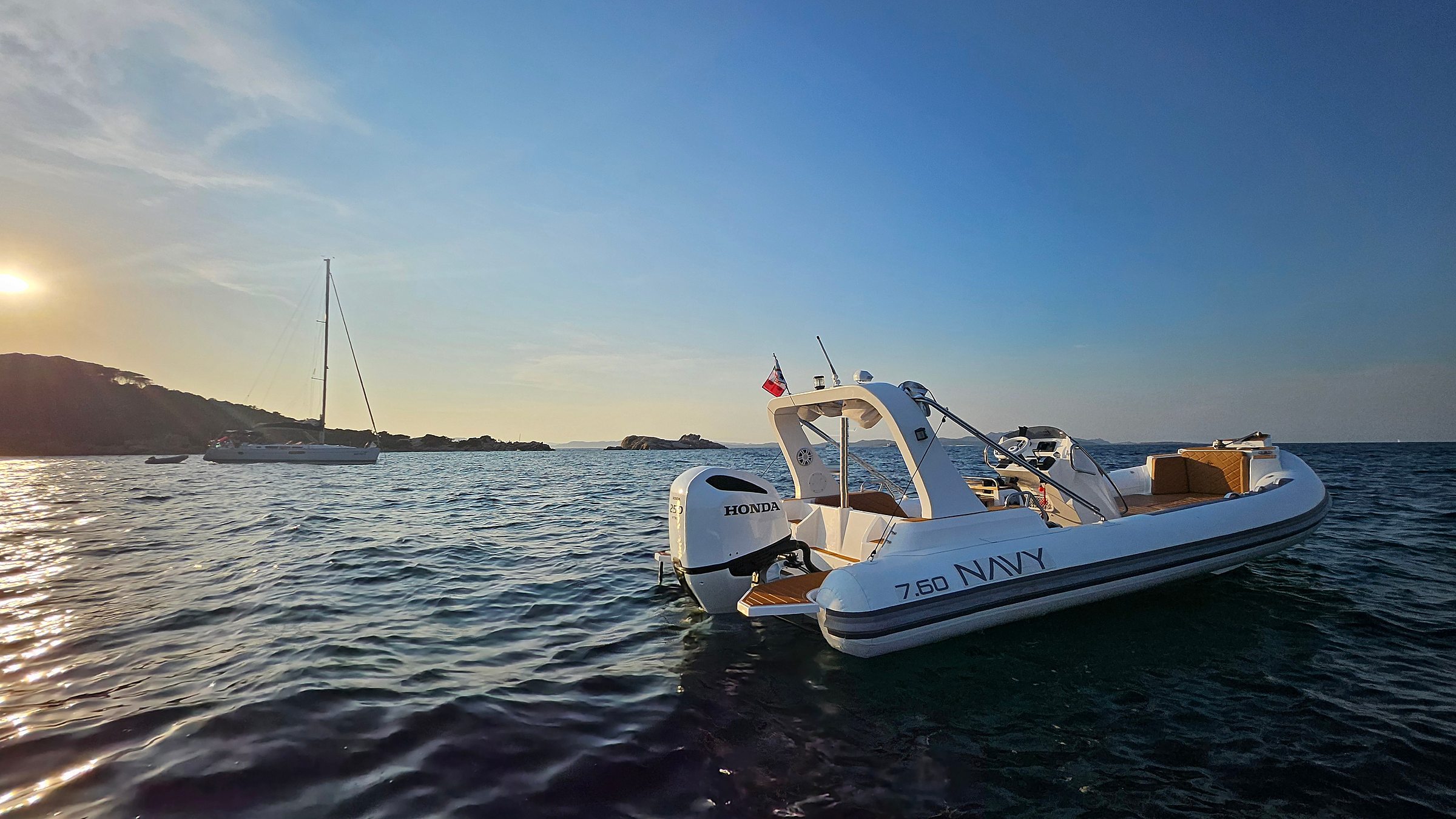
FIG. 01 — NAVY 7.60 at anchor, bow three-quarter view, tan upholstery and Honda outboard visible. With the engine off you read the plate and stow the load.
PLATE 03 — The trial boat in four numbers
6
tests to run, always in the same order
From planing to the ladder.
7.60
metres overall of the trial boat
NAVY 7.60.
2.89
metres of beam, from the spec sheet
NAVY 7.60.
250
horsepower of the outboard on the trial boat
On the NAVY 7.60 we recommend 200/250 hp.
FIG. 02 — NAVY 7.60 at anchor, stern three-quarter view, white Honda 250 and scrub-covered hills behind: the same model and the same engine as the trial boat.
PLATE 04 — The trial, step by step · Naviglia vision
Six tests, one boat
One: getting on the plane
WITH THE REAL LOAD · FIRM THROTTLE · EYES ON THE HORIZON
The boat has to climb out of the water with the people and the things you will carry. How long the bow stays high, and whether you can see ahead from the helm, tells you whether the power is enough.
Two: running trim
THE OUTBOARD TILTS · THE BOW FOLLOWS
On the plane you look for the point where the boat runs clean and straight. You raise and lower the engine a little at a time, and watch the bow.
Three: the tight turn
ONE WAY, THEN THE OTHER · AT CRUISING SPEED
Firm helm, then the other way. A boat that turns composed, without jerks and without the stern sliding out, will hold on when the sea changes too.
Four: stability at rest
ENGINE IN NEUTRAL · PEOPLE ON ONE SIDE
Boat stopped, two or three people sitting on the same tube. How far it heels, and how it comes back upright: this is the test for anyone who swims and spends time at anchor.
Five: noise and vibration
TALK IN A NORMAL VOICE · ONE HAND ON THE CONSOLE
You will always hear the engine. What you should not hear is anything that rattles: panels, hatches, gear in the lockers.
Six: back up the swim ladder
ENGINE OFF · FROM THE WATER TO THE PLATFORM
The last test is done wet: you go down into the water and climb back up as you would after a swim. It is the one you will remember every summer day.
The six tests have an order, and it is not random: you start with what needs the most power and the most open water, getting on the plane, and finish with what is done at rest, climbing back aboard from the water. That way the boat is tested in a single outing, without doubling back, and each test prepares the next: trim is set only once you are on the plane, the turn is judged only with the right trim, stability is measured only with the engine in neutral.
The table holds the list to keep in your pocket: what you test, how you do it, and what the boat's behaviour tells you. No instruments are needed: eyes, ears and hands are enough, along with the patience to repeat a test when something does not convince you. Below the table you will find the six tests one by one, with photographs of the NAVY 7.60.
Six-point checklist for a RIB sea trial: what is tested, how it is done and what the boat's behaviour tells you
Test
How it is done
What it tells you
1 · Getting on the plane
With the real load, firm throttle until the boat levels out on the water.
If it climbs out quickly and you can see the horizon from the helm, the power is right for your load; if it struggles, it is at the limit.
2 · Running trim
On the plane, engine raised and lowered a little at a time with the trim control.
If you find a point where it runs clean and straight, hull and engine are working together; if it lists to one side, the weight on board needs redistributing.
3 · Tight turn
At cruising speed, firm helm one way and then the other.
A composed turn, with no jerks and no stern sliding out, means a boat that holds; everyone on board must always have something to hold on to.
4 · Stability at rest
Engine in neutral, two or three people sitting on the same tube.
How far it heels and how it comes back upright: it matters to anyone who swims, fishes or spends time at anchor.
5 · Noise and vibration
At cruising revs, talk in a normal voice and rest a hand on the console and the grab rails.
You will hear the engine; whatever rattles or vibrates tells you how the console, hatches and lockers are fixed.
6 · Back up the swim ladder
With the engine off, go down into the water and climb back onto the platform.
If you climb up without effort and find secure handholds, you will swim more gladly, all summer long.
Checklist by Naviglia Yachts · the sea trial of NAVY RIBs is run on the NAVY 7.60 powered by a Honda 250.
PLATE 06
One by one
Six tests, in order
Each test has its own question. Below you will find what to watch, what to do and what the boat tells you, on the NAVY 7.60 we take out to sea.
FIG. 03 — Naviglia vision: the NAVY 7.60 on the plane, with the bow slightly raised.
01
Test 1 · Power and load
Getting on the plane
You set off with the real load and open water ahead. You open the throttle decisively, without snatching at it, and watch three things: how long the bow stays high before the boat levels out on the water, whether you can still see the horizon from the helm, and whether the engine picks up revs without labouring.
What it tells you: if the RIB climbs out of the water quickly even with people on board, the power is right for your use; if it struggles, it is at the limit, and with a little more weight it will be even more so. On the NAVY 7.60 we recommend 200/250 hp, and our trial boat carries a Honda 250 outboard. The engine on your NAVY is your choice, by power and by make, from the outboards we fit to NAVY RIBs: Honda, Yamaha and Mercury.
FIG. 04 — Stern of the NAVY 7.60: fibreglass roll bar, white Honda outboard and lettering on the tube.
02
Test 2 · The angle of the engine
Attitude and trim
Trim is the control that changes the angle of the outboard relative to the transom. With the engine fully down the bow stays low; raising it a little at a time lifts the bow and the boat runs lighter on the water. Overdo it, and the bow starts to bob in a steady rhythm while the propeller loses its grip.
The test is to find the right point: the one where the RIB runs straight and clean, without slamming and without leaning to one side. What it tells you: if that point exists and you find it in a few touches, hull and engine are working together. If the boat stays heeled on one side, look at how people are sitting: often moving one weight is enough. Ask whoever is with you to show you the control: it is the first thing you learn when you learn how to drive a RIB.
FIG. 05 — Naviglia vision: the wake seen from above. In a turn, it is the wake that tells you whether the stern is sliding.
03
Test 3 · Grip
The tight turn
The tight turn is tested at cruising speed, not flat out, and after warning everyone on board. Firm helm one way, then the other. You watch how the boat leans into the turn, whether the stern slides outwards, whether the engine suddenly gains revs without pushing, and what shape the wake takes.
What it tells you: a composed turn, without jerks, means a boat that holds even when the sea changes. Watch the people too: anyone seated must always have something to hold on to. On the NAVY 7.60 the helm seat has a grab rail as standard, and the tubes are in ORCA Hypalon-neoprene by Pennel & Flipo, 1.3 mm thick, with double or triple hand welding at the critical joints.
FIG. 06 — NAVY 7.60 at anchor under a wide blue sky, Honda 250 and a scrub-covered hill.
04
Test 4 · At anchor
Stability at rest
Engine in neutral, boat stopped. Two or three people sit on the same tube, then all move across to the other. You watch how far the boat heels and how calmly it comes back upright; you also try walking on deck, from bow to stern, as you would to fetch something from a locker.
What it tells you: this is the test that counts for anyone who swims, fishes or spends the afternoon at anchor with friends, which is the longest part of any day at sea. The NAVY 7.60 has a beam of 2.89 metres, and its standard decking is EVA synthetic teak, stain-resistant and non-slip: walking barefoot or with wet feet, you feel at once whether your footing is sure.
FIG. 07 — Dead-astern view of the NAVY 7.60: Honda 250 outboard centred between the two swim platforms.
05
Test 5 · Ears and hands
Noise and vibration
At cruising revs you talk in a normal voice: with whoever is sitting at the bow, with whoever is at the helm. Then you rest a hand on the console, on the seat grab rail, on the windscreen, and listen for anything vibrating, a hatch banging, gear in the lockers shifting with every wave.
What it tells you: engine noise depends on the engine, and you will always hear it; what rattles depends on how the boat is built and put together. On NAVY RIBs the hull, deck, stern platforms and console are in fibreglass with extra-thick laminates, in white or black, and we build every boat to measure, one at a time, with no assembly line. At sea, the work done ashore can be heard, or it cannot: that is exactly what you are listening for.
FIG. 08 — Stainless swim ladder recessed in the teak-effect aft platform of the NAVY 7.60.
06
Test 6 · After the swim
Back up the ladder
The last test is always done with the engine off. You open the ladder, go down into the water and climb back up as you would after a swim offshore: unaided, with wet hands. You watch where the ladder sits in relation to the engine, how comfortable the first rung under the water is, where you put your hands as you climb, and whether the platform feels secure underfoot.
What it tells you: an easy climb back means more frequent swims, for you and for anyone with less strength in their arms. On the NAVY 7.60 the stern bathing platforms with folding ladder are standard, and on the 7.60 in the photographs the platforms are finished in teak effect. Try them with wet feet: that is how you will use them in summer.
Engine · tubes · equipment · price · lead times · warranty
“Which engine do you recommend?” A NAVY can be bought with or without an engine. The engine is chosen separately, by power and make, and we quote it together with the boat: that way you have the final figure in front of you. On the NAVY 7.60 we recommend 200/250 hp; the makes are Honda, Yamaha and Mercury. If you already have an engine, we assess the match on the model you choose.
“What are the tubes made of?” From the 4.80 to the 7.60 they are in ORCA Hypalon-neoprene by Pennel & Flipo, 1.3 mm thick; the 9.50 Cabin has ORCA Hypalon-neoprene tubes too. There are three standard colours: Deep Night, White Stone and Navy Blue.
“What comes as standard?” On the RIBs up to the 7.60: console with full gauges, roll bar with navigation lights, stern bathing platforms, rear steel ladder and standard upholstery. The NAVY 7.60 also has the automatic bilge pump and the repair kit.
“How much does it cost, and how long does it take?” The list price of the NAVY 7.60 is from €33,000 + VAT · engine not included. The NAVY 7.60 is built to order: about three months from order confirmation. When a boat is in stock, it is ready within 7 working days of order confirmation. Up to 15 years' warranty.
FIG. 09 — NAVY 7.60 cockpit seen from the water: console, quilted tan seats and roll bar with bimini.
PLATE 08
04
By appointment
How to book our sea trial
We run sea trials of NAVY RIBs in Nettuno, by appointment: we set the day together. The boat is our NAVY 7.60 powered by a Honda 250: the same model and the same engine as in the photographs on this page. To book one, a message is enough: write to us that you would like to try a NAVY at sea. If you wish, tell us straight away which size you have in mind and how you will use the boat.
The NAVY 7.60 is the trial boat even for those looking at another size. Anyone interested in the NAVY 9.50 Cabinato tries the 7.60 in the meantime, to judge trim, handling and solidity. And we handle the sale directly ourselves: there is no one to look for in your area, everything comes back to us, from configuration to delivery.
FIG. 10 — NAVY 7.60, stern three-quarter view with Honda 250, swim platforms and swim ladder: the ladder is down, the sixth test is ready.
Three things to know
Where. In Nettuno; the showroom is in Aprilia (LT), between Rome and Latina.
Which boat. The NAVY 7.60, 7.60 × 2.89 m, with a Honda 250.
Guide written by Naviglia Yachts, a brand of Michelessi Corporation Srl · updated 25 September 2026
“The real difference is felt from the very first contact with the water.”
— Naviglia Yachts
PLATE 10
The questions you really ask us
Frequently asked questions
On the sea trial, on driving a RIB and on the licence: the answers we give in person. One at a time: open one and the other closes.
What do you look at on a RIB sea trial?
On a RIB sea trial you look at six things, in order: getting on the plane with the real load, running trim, grip in a tight turn, stability at rest with people on one side, noise and vibration, and climbing back up the swim ladder. The order lets you test the boat in a single outing, from the test that needs the most power to the one done with the engine off.
How do you drive a RIB with an outboard?
A RIB with an outboard is driven with the wheel and the control lever, which selects the gear and sets the throttle; on the plane you adjust the running trim with the trim control, which tilts the outboard. Under Italian law the licence depends on the engine: it is required above 30 kW (40.8 hp) or above the engine-capacity limits, and beyond 6 miles of the coast it is always required (art. 39 of the Italian Recreational Boating Code).
How do you drive a 40 hp RIB, and do you need a licence?
A 40 hp RIB is driven like any other, with the wheel, the control lever and the trim. In Italy, within 6 miles of the coast no boat licence is needed if the engine exceeds neither 30 kW (40.8 hp) nor the engine-capacity limits set by law, 1,000 cc for a four-stroke outboard; for a natante the minimum age is 16 (art. 39(3)). With a 40 hp we recommend up to the 6 metre: the NAVY 4.80, NAVY 5.50 or NAVY 6.00.
Can you take a NAVY RIB out on a sea trial?
Yes, in Nettuno. For sea trials of NAVY RIBs we have our own NAVY 7.60 powered by a Honda 250. Anyone interested in the cabin RIB can try the 7.60 in the meantime, to judge trim, handling and solidity. The day of the sea trial is set together with you, by appointment.
Which boat is used for the NAVY sea trial?
The NAVY sea trial is run on our NAVY 7.60 powered by a Honda 250: 7.60 metres overall and 2.89 metres of beam. On the NAVY 7.60 we recommend a 200/250 hp engine. Its list price is from €33,000 + VAT · engine not included, that is €40,260.00 incl. 22% Italian VAT.
Why should a sea trial be run with the real load?
A sea trial should be run with the real load because planing, trim and turning change with the weight on board and with how it is distributed. A RIB tried with one person alone feels livelier than it will with the family and the bags. The load always stays within the number of people on the builder's plate and in the owner's manual (art. 34 of the Italian Recreational Boating Code).
Which engine can be fitted to the RIB after the sea trial?
Honda, Yamaha and Mercury are the outboards we fit to NAVY RIBs. You choose the make, together with the power. A NAVY can be bought with or without an engine: we quote the engine together with the boat, so you have the final figure in front of you. On the NAVY 7.60 we recommend 200/250 hp; for the other sizes the recommended power is on each model's page.
The sea trial is the last step before you choose. Below you will find the sea trial page, the page of the boat we run it on and the guide to the right power for your size.
Photographs can only take you this far. Getting on the plane with your own load, the trim under your hand, the ladder after a swim: those are felt only at sea. Book the trial on the NAVY 7.60 and bring this list with you: one test at a time, in the right order. When would you like to come?